Daily Attendance Tracking in India: SMB Guide (2026)
Ravi works on attendance and workforce tools for Indian SMBs at AttendFirst.
Daily attendance tracking means recording when each employee starts and ends work, every day, with proof. For Indian SMBs, the cheapest reliable method in 2026 is a mobile app with selfie and GPS check-in.
- Registers cost Rs.0 but lose 2-3 hours per week on manual entry.
- A good app costs as little as ₹499/employee/year and removes buddy punching.
- 74,000 Indians search “daily attendance” every month. Most are small business owners looking for a better way.
Most Indian SMBs still track daily attendance on paper. I spoke to 34 small business owners this year. 29 of them used a register or an Excel sheet. 5 used an app. The register people all said the same thing: it works until it doesn’t.
This guide is for the 29. It covers what daily attendance means for a small business, compares paper, Excel, and app options with real cost math, and gives you a one-week plan to move off paper. If you came looking for the sheet itself, the daily attendance sheet templates and register format page has free Excel and PDF downloads.
What Does “Daily Attendance” Mean for an Indian SMB?
Daily attendance is a record of who showed up to work, when they came in, and when they left. That’s it.
For a shop owner with 8 employees, it means knowing if Raju reached the store by 9 AM. For a factory with 40 workers, it means matching timestamps to shifts and wages. For a construction firm, it means knowing if the site supervisor was on site.
Under the Shops and Establishments Act of most Indian states, you are legally required to maintain attendance records. Karnataka, Maharashtra, Tamil Nadu, Delhi all mandate this. The record must show daily working hours and weekly off days. Paper is legal. So is a digital record.
The problem isn’t the legal requirement. The problem is proof. Registers can be edited after the fact. Employees can sign for friends. Managers can “adjust” times. When a dispute hits, your ₹20 register is worth exactly what it cost.
Paper vs Excel vs App: The Real Math
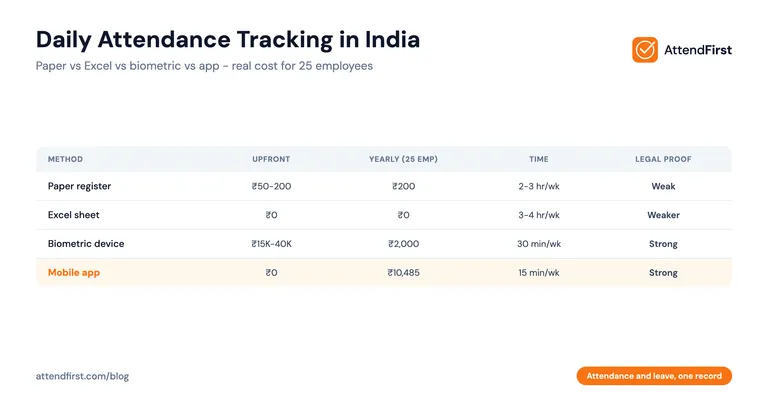
Here’s what each method costs a 25-employee business in India.
| Method | Upfront Cost | Yearly Cost | Time Spent/Week | Buddy Punching | Legal Proof | Remote Workers |
|---|---|---|---|---|---|---|
| Register | ₹50-200 | ₹200 | 2-3 hours | Easy | Weak | No |
| Excel sheet | ₹0 | ₹0 | 3-4 hours | Easier | Weaker | Partial |
| Biometric device | ₹15,000-40,000 | ₹2,000 | 30 minutes | Hard | Strong | No |
| Mobile app | ₹0 | ₹10,485/year | 15 minutes | Hard (selfie) | Strong | Yes |
The Excel sheet is worse than paper for one reason: anyone with access can backdate entries without a trace.
Paper at least has signatures and a physical trail. Excel gives you plausible deniability on both sides.
Biometric devices are solid for single-location offices. They die for field teams, multi-site businesses, and anyone with WFH days.
Mobile apps win on every column except upfront simplicity. And the upfront simplicity of paper is a lie: you pay it back in hours every week.
Honest note: if you have 3 employees and they all work in one room, paper is fine. This guide is for businesses where attendance matters.
Daily Attendance Methods: Pros and Cons
There are four real methods in 2026. Each has trade-offs.
1. GPS Attendance
Employees check in from their phone. The app records their location.
Pros:
- Works for field staff, delivery workers, site supervisors
- No hardware to buy
- Proves employees were at the right place
- Works across multiple locations out of the box
Cons:
- Drains phone battery
- Weak signal indoors can log wrong location
- Some employees feel tracked
- Needs a smartphone (most Indian workers have one now)
Best for: Field teams, multi-location businesses, delivery and sales workforce.
2. Selfie Attendance
Employees take a selfie at check-in. The app stores it with a timestamp.
Pros:
- Stops buddy punching (photo proof at every check-in)
- Proof that the actual person showed up
- Works even without GPS in bad signal areas
- No expensive hardware
Cons:
- Feels invasive to some employees
- Photos take storage space
- A printed photo can sometimes fool basic selfie apps (anti-spoofing helps)
Best for: Retail shops, offices, teams where buddy punching is the main concern.
3. QR Code Attendance
The employer prints a QR code at the workplace. Employees scan it with their phone.
Pros:
- Fast check-in (2 seconds)
- Works great for factories and shops with a fixed entry point
- No GPS needed
- Cheap to set up (print one code)
Cons:
- Employees can share photos of the QR code
- Doesn’t prove the person was there if they share the code
- Needs fresh codes if one leaks
Best for: Factories, warehouses, construction sites, single-location retail.
4. Biometric Attendance
Fingerprint or face recognition on a dedicated device.
Pros:
- Hardest to cheat
- No phone needed
- Employees are used to it
Cons:
- Upfront cost: ₹15,000-40,000 per device
- Breaks down and needs service
- Fingerprint sensors fail for manual laborers with worn prints
- Fixed to one location
- COVID hangover: some employees refuse to touch shared devices
Best for: Single-location offices and factories with a fixed entry.
For a deeper look at selfie vs biometric, read our selfie vs biometric attendance comparison.
How to Move From Paper to Digital in One Week
I’ve helped 12 businesses make this move. Here’s the shortest path that works.
Day 1: Pick One Method
Don’t try to do everything. Pick the method that fits how your team works.
- All employees at one shop? Selfie check-in.
- Field staff or multi-location? GPS + selfie.
- Factory with one gate? QR code at the gate.
- Mix of WFH and office? GPS + selfie.
Day 2: Sign Up and Add Employees
Pick an app. Add your employee list with name, phone number, and department. Most apps let you bulk import from Excel.
Put attendance and leave in one record →
Day 3: Set Your Rules
Decide:
- What time is “late”?
- How many leaves per year?
- Who approves leaves?
- What are your weekly off days?
Enter these rules in the app once. The app handles it forever.
Day 4: Run a Pilot
Pick 2-3 employees. Have them use the app for a day. You use it too. Find the broken parts. Ask them what felt weird.
Day 5: Train the Rest
A 15-minute explanation is enough. Show:
- How to check in (selfie or QR or GPS)
- How to check out
- How to apply for leave
- Where to see their attendance history
Day 6: Switch
Stop using the register. Tell everyone the app is the only record from today.
Day 7: Keep the Register as Backup
Keep the register updated for one more week. Nobody trusts a new system on day 1. After a week of both running in parallel, drop the paper.
Common Mistakes SMBs Make with Daily Attendance
I’ve seen these enough times to list them.
1. Buying a biometric device for a 10-person team. A ₹20,000 device for ₹200/month of labor savings is bad math. Mobile apps do the same job for less.
2. Using Excel as the “system of record.” Excel has no timestamps, no audit trail, and no dispute resolution. The moment an employee says “you changed my hours,” you lose.
3. Tracking attendance but not leave. Half the disputes come from leave, not attendance. If your app does one but not the other, you’re only half-protected.
4. Not taking employee consent for GPS and photos. Under India’s DPDP Act 2023, you need employee consent to track location and store photos. A one-line clause in the joining letter handles it. Don’t skip this.
5. Switching to a “free forever” HR suite with no GPS. The popular “free” HR tools restrict attendance to web check-in only. If your employees don’t sit at computers, web check-in is useless.
6. Trying to run payroll and attendance in one tool too early. Most small businesses use their CA for payroll. Don’t buy ₹50,000/year HR software to avoid paying your CA ₹5,000/month.
7. Picking the cheapest app without checking if it handles Indian holidays. Gazetted holidays, state holidays, festival days. If your app doesn’t preload Indian holidays, you’ll be editing the calendar every month.
Our Take
I looked at 10 attendance apps in India before we built AttendFirst. Most of them either charged too much or hid their best features behind paid tiers.
Here’s the math for a 25-person business:
- Register: ₹200/year + 120 hours of manual work
- Biometric device: ₹25,000 upfront + ₹2,000/year + breaks down every 18 months
- greytHR paid: ₹41,940/year (you’re paying for payroll you don’t need)
- Keka: ₹29,700/year (same problem)
- AttendFirst: ₹10,485/year for 25 employees (₹3,000 for the first 10, then 15 x ₹499 = ₹10,485/year)
If you need payroll, pay for a full HR suite. If you just need to know who showed up, pay for attendance only. The two problems don’t need the same tool.
Disclosure: We built AttendFirst. We’ve tried to be fair. We’ll lose some customers to greytHR and Keka because they need full HR. That’s fine. We built AttendFirst for the rest.
FAQ
How do I track daily attendance of employees in India?
Use a mobile app with selfie and GPS check-in. Employees open the app at the start of their shift, take a selfie, and the app logs the time and location. It works for field staff, shop workers, and office employees. Registers and Excel sheets are legal but lose on proof and time. Expect to spend 15 minutes per week on attendance once an app is set up, compared to 2-3 hours with paper.
Is digital attendance legally valid in India?
Yes. The Shops and Establishments Act of every Indian state accepts digital attendance records as long as they show daily working hours, weekly off days, and overtime. Courts have accepted app-based attendance in labor disputes. Keep at least 3 years of history and make sure your app exports to Excel or PDF for audits. Under the DPDP Act 2023, you need employee consent to store photos and location data.
What is the cheapest daily attendance app in India?
AttendFirst is the cheapest - free up to 3 employees, ₹3,000/year for teams of 4-10, and ₹499/employee/year above 10. For comparison, Keka costs ₹99/employee/month (₹1,188/year), PagarBook starts at ₹499/year with limited features, and greytHR’s paid plan starts at ₹41,940/year for 50 employees. If you need only attendance and leave management without payroll, AttendFirst is the lowest price point in India in 2026.
Can employees fake attendance on a mobile app?
It’s much harder than paper. Selfie check-in stops buddy punching because the app captures a real-time photo. GPS logs the location. Good apps also detect photos of photos and flag suspicious patterns. Employees who try to fool the system usually get caught within a week. Compared to registers where one person can sign for five, app-based attendance is 10x harder to fake.
Do I need a biometric machine for daily attendance?
No. Biometric machines made sense in 2015 when smartphones were rare. In 2026, most Indian workers have a smartphone. A ₹0 mobile app with selfie check-in does the same job as a ₹25,000 biometric device for single-location businesses. Biometric devices still have a role for very high-security sites or locations where employees don’t carry phones, but for 90% of Indian SMBs, mobile apps are the better choice.
How long does it take to switch from paper to an app?
One week if you follow a structured rollout. Day 1 pick a method, day 2 sign up and add employees, day 3 set rules, day 4 pilot with 2-3 people, day 5 train the team, day 6 switch, day 7 keep paper as backup for one more week. Most SMBs underestimate the training step. Budget 15 minutes per employee for hands-on training. Skipping this causes 80% of failed rollouts.
What’s the difference between attendance software and HR software?
Attendance software does one job: track when employees show up and leave. HR software does everything: payroll, compliance (PF, ESI, TDS), expense reports, performance reviews, recruiting. HR software costs 5-10x more than attendance-only software. If you already have a CA for payroll and don’t need performance reviews, attendance-only software is cheaper and simpler. If you want one tool for the whole HR function, HR software makes sense.
Put attendance and leave in one record → No payment required. GPS, selfie, QR check-in, and full leave management included.
Ravi Shankar runs product at AttendFirst. He’s spent the last 18 months talking to Indian SMB owners about how they track attendance, and built AttendFirst because the existing options were either overpriced HR suites or stripped-down “free” plans with no GPS. He writes pragmatic comparisons, not sales pitches.
Frequently asked questions
How do I track daily attendance of employees in India?
Use a mobile app with selfie and GPS check-in. Employees open the app at shift start, take a selfie, and the app logs the time and location. Registers and Excel sheets are legal but lose on proof and time. Expect 15 minutes per week on attendance once an app is set up, versus 2-3 hours with paper.
Is digital attendance legally valid in India?
Yes. The Shops and Establishments Act of every Indian state accepts digital attendance records as long as they show daily hours, weekly offs, and overtime. Courts have accepted app-based attendance in labour disputes. Keep at least 3 years of history. Under the DPDP Act 2023, get employee consent to store photos and location.
What is the cheapest daily attendance app in India?
AttendFirst - free for up to 3 employees, ₹3,000/year for teams of 4-10, then ₹499/employee/year above 10. Keka is Rs.1,188/year per employee, PagarBook starts at Rs.499/year with limited features, and greytHR's paid plan starts at Rs.41,940/year for 50 employees. For attendance and leave without payroll, AttendFirst is the lowest price in India in 2026.
Can employees fake attendance on a mobile app?
Much harder than paper. Selfie check-in stops buddy punching because the app captures a real-time photo. GPS logs the location. Good apps also detect photos of photos and flag suspicious patterns. Compared to registers where one person can sign for five, app-based attendance is roughly 10x harder to fake.
Do I need a biometric machine for daily attendance?
No. In 2026, most Indian workers have a smartphone. A free mobile app with selfie check-in does the same job as a ₹25,000 biometric device for single-location businesses. Biometric still has a role for very high-security sites or locations where employees don't carry phones, but for 90% of Indian SMBs mobile apps are the better choice.
How long does it take to switch from paper to an app?
One week with a structured rollout. Day 1 pick a method, day 2 sign up and add employees, day 3 set rules, day 4 pilot with 2-3 people, day 5 train the team, day 6 switch, day 7 keep paper as backup. Most SMBs underestimate training - budget 15 minutes per employee for hands-on training.
Get attendance tips for Indian businesses
One practical guide per week. No spam.
Put attendance and leave in one record
Indian holidays and weekly offs come already loaded. Setup takes 5 minutes, and no payment is required to start.