Biometric vs Selfie Attendance for Indian Businesses (2026)
Payal focuses on leave management and compliance workflows for Indian businesses.
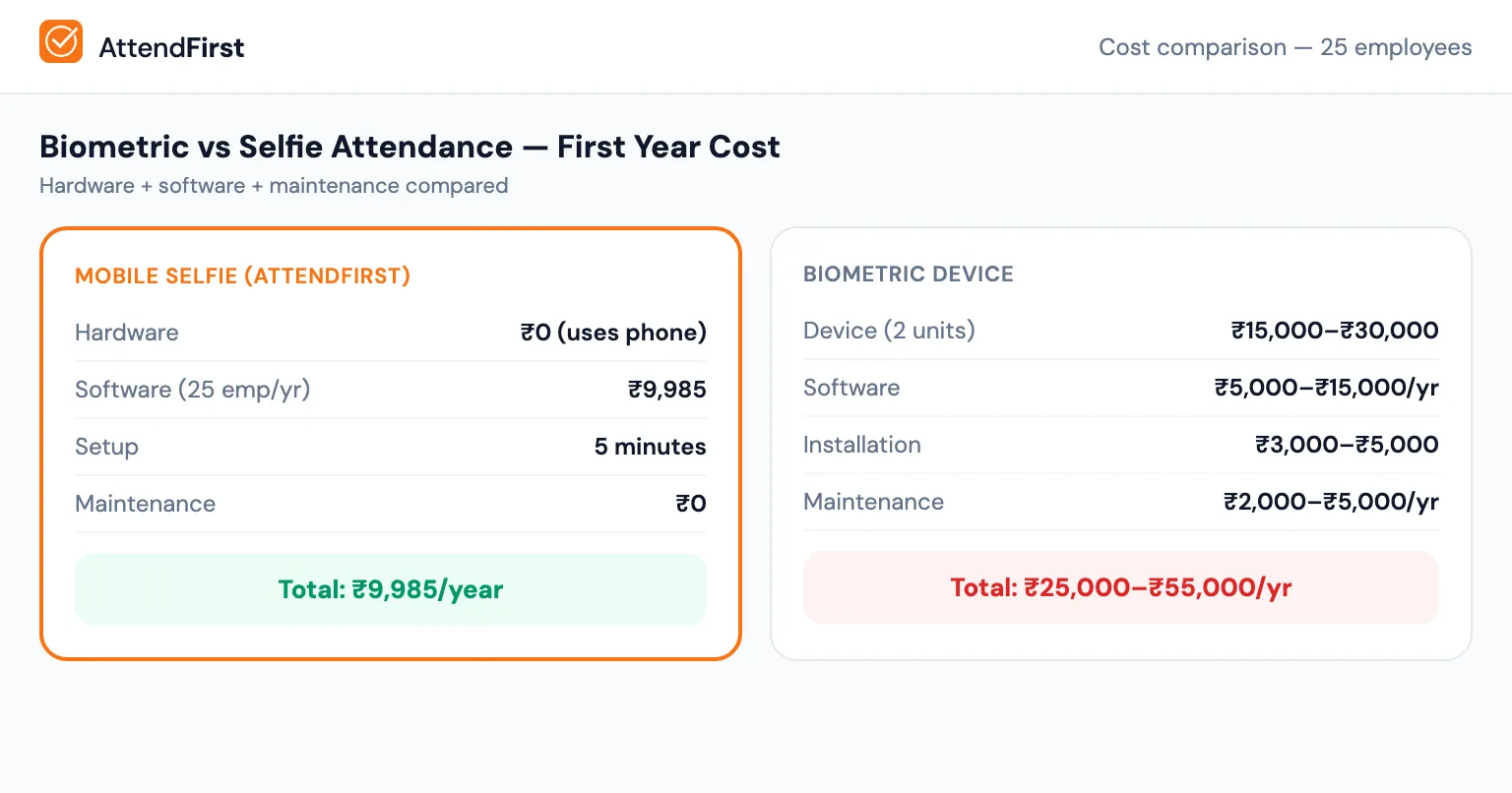
Selfie and GPS attendance apps cost ₹0 to ₹499/employee/year with zero hardware, while biometric machines cost Rs.15,000-50,000 upfront plus Rs.3,000-5,000/year maintenance. Selfie apps work for multi-location teams and field staff; biometric suits single-location factories with 100+ workers. Here’s an honest comparison for Indian businesses.
What Is Biometric Attendance?
Biometric attendance systems use physical characteristics to identify employees:
- Fingerprint scanners: most common in India (ZKTeco, eSSL)
- Face recognition: newer, touchless devices
- Iris scanners: high-security environments
- Card-based: RFID/proximity cards (not true biometric)
You buy a device, mount it at the entrance, enroll each employee’s fingerprint or face, and they scan every day to check in.
What Is Selfie/GPS Attendance?
Selfie attendance uses the employee’s own phone:
- Employee opens the app (works in any browser)
- Taps “Check In”
- App captures a selfie photo + GPS location automatically
- Manager sees it on the dashboard instantly
There is no hardware to buy, no installation, and nothing to maintain. If you’re currently using a paper attendance register, this is an even bigger upgrade.
Honest Comparison
| Factor | Biometric Machine | Selfie + GPS App |
|---|---|---|
| Hardware cost | ₹3,000-15,000 per device | ₹0 (employees use their phones) |
| Installation | Needs electrician, wall mounting, network setup | None. Just share a link |
| Setup time | 1-3 days (device + enrollment) | 5 minutes |
| Monthly maintenance | Sensor cleaning, software updates, breakdowns | None |
| Per-location cost | One device per entrance | Same app works everywhere |
| Multi-location | Separate device per location (₹3,000+ each) | One dashboard for all locations |
| Buddy punching | Prevented (fingerprint is unique) | Prevented (selfie photo is proof) |
| Location verification | Only proves they’re at the machine | GPS proves exact location |
| Power dependency | Needs electricity, backup battery | Works on phone battery |
| Internet dependency | Some need LAN/WiFi, some store offline | Needs mobile data (any phone) |
| Works during power cuts | Battery backup (2-4 hours) | Yes (phone has its own battery) |
| Replacement cost | ₹3,000+ if device breaks | ₹0 |
| Hygiene | Shared surface (fingerprint), a post-COVID concern | Touchless |
The Real Cost Comparison
Biometric Machine (3 Locations)
| Item | Cost |
|---|---|
| 3 devices (eSSL, basic) | ₹15,000 |
| Installation + wiring | ₹3,000 |
| Annual maintenance contract | ₹3,000/year |
| Software license | ₹2,000-5,000/year |
| Replacement (1 device breaks in 2 years) | ₹5,000 |
| Total (Year 1) | ₹23,000-28,000 |
| Total (Year 2+) | ₹5,000-8,000/year |
Selfie + GPS App (3 Locations, 30 Employees)
| Item | Cost |
|---|---|
| Hardware | ₹0 |
| Installation | ₹0 |
| AttendFirst (30 employees, ₹3,000 for the first 10, then 20 x ₹499 = ₹12,980/year) | ₹12,980/year |
| Maintenance | ₹0 |
| Total (Year 1) | ₹12,980 |
| Total (Year 2+) | ₹12,980/year |
For a 30-employee business with 3 locations, the app-based approach costs 46-55% less in Year 1 and remains cheaper every year after.
When Biometric Machines Make Sense
Biometric machines are the right choice when:
- High-security environments: factories handling sensitive materials, banks, government offices
- No smartphone policy: workplaces where personal phones are banned
- Very large workforce (500+ employees) in a single location where throughput matters
- Compliance requirements that specifically mandate biometric hardware
When Selfie + GPS Makes More Sense
App-based attendance is better when:
- Multiple locations: one dashboard instead of one device per site
- Field workers: construction, delivery, security guards who aren’t at a fixed location
- Budget is tight: no upfront hardware cost
- Quick setup needed: running in 5 minutes, not 3 days
- Employees already have phones: which is almost everyone in India today
What About QR Code Check-In?
There’s a third option: QR code attendance. Print a QR code poster at each location. Employees scan it with their phone to check in. This verifies they were physically at the location without needing GPS (useful indoors where GPS can be inaccurate).
AttendFirst supports all three methods (GPS, selfie, and QR code), so you can use whatever works best for each location.
Common Concerns
“Employees will fake their GPS location.” GPS spoofing apps exist, but they require technical knowledge most employees don’t have. The selfie photo provides a second layer of verification. Combined, they’re as reliable as fingerprint scanners for typical small business use.
“Biometric is more accurate.” For identity verification, yes, a fingerprint is unique. But for attendance purposes, a timestamped selfie photo with GPS coordinates serves the same purpose. If someone disputes their attendance, you have photographic proof with location data.
“What about employees without smartphones?” In 2026 India, smartphone penetration is over 75%. For the rare employee without one, QR code check-in works on any phone with a camera, or the admin can add manual attendance entries.
The bottom line
Most Indian SMBs (10-75 employees) do not need a biometric machine. A selfie + GPS app provides the same anti-fraud protection at a fraction of the cost, with no hardware to maintain. Automated daily attendance reports and leave management are built in too, which biometric machines don’t offer.
AttendFirst includes GPS, selfie, and QR code check-in, and it keeps leave in the same record, which no fingerprint reader does. Teams of 4-10 pay ₹3,000/year, ₹499/employee/year above 10, and up to 3 employees costs nothing. No hardware required.
Frequently asked questions
Is a selfie attendance app as accurate as a biometric fingerprint machine?
For attendance use - yes. A timestamped selfie combined with GPS coordinates creates a two-factor record (identity plus location) that is at least as reliable as a fingerprint scan, which only proves a specific finger was pressed at a specific machine. Biometric fingerprints are more accurate for identity verification (forensic-grade uniqueness), but attendance is not a forensic use case. For a typical Indian SMB with 10-75 employees, selfie + GPS is sufficient and avoids the hardware breakdown, dirty-hands failures, and per-location cost of biometric devices.
How much does a biometric attendance machine cost in India?
Basic fingerprint machines start at Rs.3,000-5,500 per device, enterprise fingerprint devices run Rs.6,500-12,000, face recognition tablets cost Rs.8,000-18,000, and wall-mounted face recognition units cost Rs.15,000-25,000. Add 20-40% in year one for installation, cabling, UPS backup, and enrollment time, then Rs.1,500-10,000 per year in AMC afterwards. A mobile selfie app like AttendFirst costs nothing for the first 3 employees, ₹3,000/year for teams of 4-10, and ₹499 per employee per year above 10 - about 3-4x cheaper over three years for a 20-person team.
When is a biometric machine still the right choice?
Biometric hardware makes sense for shop floors where personal phones are banned for safety, throughput points with 200+ scans in 15 minutes, environments where phones are unreliable (wet food processing, cold storage), or when a compliance audit explicitly mandates fingerprint logs. If none of those apply, the hardware is convenience money - you are paying for the ritual of scanning at a machine, not for attendance accuracy.
Can employees fake GPS attendance by spoofing their location?
GPS spoofing apps exist but require technical knowledge most employees do not have, and they do not defeat the selfie component of a combined selfie + GPS check-in. AttendFirst captures both location and a front-camera photo on every check-in, so an employee would have to both spoof GPS and get someone else's face in front of the camera. For typical SMB use, this is as reliable as fingerprint scanners. High-security environments should still use dedicated biometric hardware.
Can selfie attendance work without an internet connection?
Most browser-based selfie attendance apps need a brief mobile data connection at check-in (a few KB) to send the photo and GPS coordinates to the server. Factory and warehouse areas with weak signal are the main constraint - employees can step outside or near an entrance to check in. If connectivity is a chronic issue, a QR-code kiosk at the gate with a store-and-forward tablet is the usual fallback, still cheaper than a wall-mounted biometric device.
Get attendance tips for Indian businesses
One practical guide per week. No spam.
Put attendance and leave in one record
Indian holidays and weekly offs come already loaded. Setup takes 5 minutes, and no payment is required to start.