Attendance Software for Manufacturing Units in India
Arjun researches attendance, leave, and workforce trends for Indian small businesses. He writes data-driven comparisons and guides.
Manufacturing attendance software uses QR codes, selfie verification, and GPS to track workers across factory floors, warehouses, and installation sites, without biometric machines that fail with greasy hands or long shift-change queues. Indian manufacturing units with 10-75 workers can set this up in 5 minutes for ₹0 to ₹499/employee/year. Here’s what works.
How manufacturing companies track attendance today
The register at the gate
Most Indian factories use a register at the main gate. Security guard watches employees sign in. Problems:
- Workers rushing in at shift start create long queues
- Illegible signatures (especially from workers who aren’t comfortable writing)
- No way to catch buddy signing: one worker can sign for another
- If you have multiple gates or entry points, you need a register at each
- Month-end compilation takes hours of manual counting
The biometric machine
Larger factories install fingerprint or face recognition machines at the gate. Better than registers, but:
- Machines cost ₹5,000-15,000 each. Multiply by number of gates and buildings
- Fingerprint scanners fail with dirty, oily, or calloused hands, common in manufacturing
- Machines break down in dusty, humid environments
- Queue bottlenecks at shift change when 50+ workers need to scan
- Maintenance and AMC costs add up
- No location data for workers at off-site installations
Excel compiled from registers
Some factories have an office person who transfers register data into Excel daily. This is a full-time task for factories with 50+ workers. Errors are inevitable when you’re transcribing 50-100 handwritten entries every day.
What manufacturing companies actually need
Factory attendance has requirements that generic HR software ignores. The check-in method can’t depend on clean, dry hands - fingerprint readers fail the moment your workers touch oil or metal. It needs to handle 100 people checking in simultaneously at shift change without creating a 15-minute queue at one machine. Workers at multiple entry points (gate, warehouse, loading dock) all need a way in. Supervisors need to override attendance for the few who forgot their phone during the morning rush.
Shifts matter. Day shift (8 AM-5 PM) and night shift (8 PM-5 AM) have different late thresholds and different half-day calculations. Installation crews at client sites need their location captured - you can’t verify off-site attendance with a machine bolted to your own gate. And the monthly report needs to give your payroll person something they can actually use: days present, late arrivals, overtime indication, broken out by department.
Attendance on workers’ phones
GPS and selfie check-in on workers’ phones solves most of what breaks in factories. There is no hardware at the gate - nothing to maintain, break, or replace. Workers check in on their own phones. The selfie uses the front camera, so dirty or greasy hands are not a problem. Everyone checks in simultaneously, which means no bottleneck at shift change. 100 workers can check in within 2 minutes instead of queuing for 15.
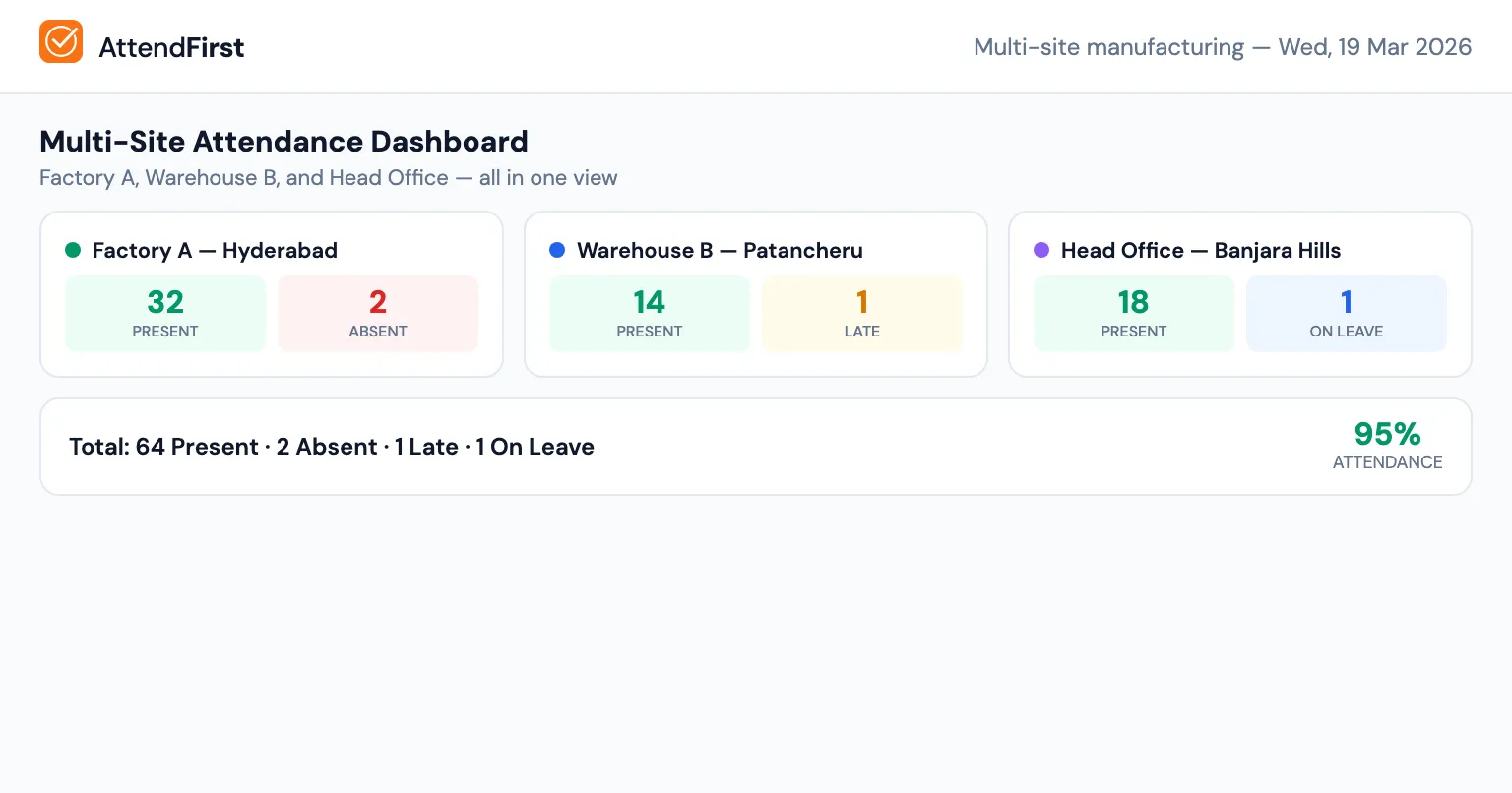
GPS coordinates confirm the worker is actually at the factory, warehouse, or client installation site. This matters for companies with workers at multiple locations - you can’t verify off-site attendance with a machine bolted to your factory entrance. Installation teams at a client site check in from that location. Maintenance crews at a different site check in there. Everyone appears on one dashboard. For a deeper look at how GPS attendance works in practice, read our GPS attendance app guide for small businesses.
“But do factory workers have smartphones?”
In 2026, yes. The vast majority do. Android smartphones are available for under ₹7,000. Among manufacturing workers aged 18-45, smartphone penetration in India exceeds 80%.
For the small number who don’t have smartphones, QR code check-in works: print a QR code at the factory gate, workers scan it with any phone (even a basic phone with a camera) or a shared tablet placed at entry.
Setting up attendance for a factory
Here’s a practical setup for a manufacturing company with 30-60 workers:
Step 1: Define your departments
Separate workers by function: Production, Warehouse, Maintenance, Quality, Office Staff. This makes reports useful: you can see attendance by department, not just company-wide.
Step 2: Add workers
Add each worker with their name, phone number, and department. For workers at multiple locations, assign them to the relevant department.
Step 3: Set working hours
Configure working hours for your shifts. If you have day shift (8 AM - 5 PM) and night shift (8 PM - 5 AM), set up both. Workers checking in outside their expected hours get flagged.
Step 4: Deploy check-in methods
For a typical factory, use a combination of methods. Most workers check in via GPS and selfie on their smartphones. Workers without smartphones use the QR code at the gate - print one poster, and any phone with a camera works. Supervisors handle exceptions manually: a worker who forgot their phone or came in with a dead battery gets their attendance added by hand with an audit trail.
Step 5: Review daily reports
Automated daily reports show:
- Who checked in and when
- Late arrivals (checked in after shift start)
- No-shows (didn’t check in at all)
- Check-in locations (GPS coordinates)
- Department-wise summary
Step 6: Monthly export
Export monthly attendance data to Excel for payroll processing. The export includes days present, late arrivals, and absences, matching what your payroll person or CA needs.
Common manufacturing scenarios
Small workshop (10-15 workers)
If you’re running an attendance register at the workshop door, the owner typically spends an hour every month counting days for salary calculation. GPS and selfie check-in on workers’ phones removes that entirely - the monthly report generates itself. Free for up to 3 workers, ₹3,000/year for 4-10 workers, ₹499/worker/year for each worker above 10.
Medium factory (30-50 workers)
A biometric machine at the gate that breaks every few months from dust is a factory-floor reality. Workers with rough hands get rejected; the queue at shift change stretches to 15 minutes. Phone-based GPS and selfie check-in has no hardware to break, no queue, and no rejection problem for calloused hands. Supervisors can add manual entries for exceptions. The cost runs ₹3,000 to ₹22,960/year depending on team size - less than one biometric machine before you count AMC and replacement costs.
Factory + off-site installation team
When 40 workers are at the factory and 10 are doing installations at client sites across the city, a gate-mounted machine tells you nothing about the off-site crew. GPS attendance captures the exact location of every check-in: factory workers show factory coordinates, the installation team shows client-site coordinates, and the manager sees everyone on one dashboard. For 50 employees, that’s ₹22,960/year with no additional hardware at any site.
Leave management for factories
Attendance and leave are connected: you can’t track one accurately without the other. Manufacturing companies need PL, SL, and CL tracked separately with different quotas - not lumped into one “leave” bucket. Workers frequently need half-day leave for personal errands, so the system has to count 0.5 days properly. The supervisor should be able to approve or reject requests before the worker takes the day off, and workers who join mid-year need a proportional quota without anyone doing manual arithmetic. Indian gazetted holidays (Republic Day, Independence Day, Diwali, and the rest) should come preloaded so you’re not rebuilding the calendar every year.
A good attendance system handles all of this in the same tool. If leave is tracked in Excel and attendance in an app, you’ll have conflicting data at salary time.
What to look for
When evaluating attendance software for your manufacturing company:
| Must-Have | Why |
|---|---|
| GPS + selfie (no fingerprint) | Dirty/calloused hands make fingerprint unreliable |
| QR code fallback | For workers without smartphones |
| Manual entry option | Supervisor override for exceptions |
| Department-wise reports | Separate production from warehouse from office staff |
| Excel export | Your CA or payroll person needs it in Excel |
| Leave management built-in | Attendance and leave must be in one system |
| Mobile-first | Workers don’t sit at computers |
| Works offline at check-in | Some factory areas have weak signal |
| Free plan for small teams | Try before committing, especially if you’re replacing a register |
The cost comparison
For a 40-worker manufacturing unit:
| Method | Annual Cost |
|---|---|
| Paper register | ₹500 (notebooks) + 2-3 hours/month of manual counting |
| Biometric machine (1 gate) | ₹10,000-15,000 (device) + ₹3,000-5,000/year AMC |
| Biometric machines (3 gates) | ₹30,000-45,000 (devices) + ₹9,000-15,000/year AMC |
| GPS + selfie attendance app | ₹17,970/year (₹3,000 for the first 10, then 30 x ₹499 = ₹17,970/year) |
Phone-based attendance is cheaper than biometric machines from year one. No hardware to break, maintain, or replace. No AMC contracts. No queue bottlenecks.
AttendFirst records attendance and leave in one place: GPS and selfie check-in, QR stations at the gate, leave balances that count around your weekly offs and holidays, and Excel export. Overnight shifts record against the date the shift started, so a night worker’s month adds up the way you count it.
Frequently asked questions
What is the best attendance software for a manufacturing unit in India?
For a manufacturing unit with 10-75 workers, a phone-based attendance app using GPS, selfie, and QR code check-in is usually the best fit - it avoids the fingerprint-failure problem on dirty or calloused hands, eliminates queue bottlenecks at shift change, works across multiple gates and off-site installation sites, and costs ₹0 to ₹499/employee/year. Biometric face recognition hardware is the alternative for shop floors where personal phones are banned; fingerprint machines are generally a poor fit for factory environments because oil, grease, and wear degrade sensor accuracy.
Can factory workers without smartphones use attendance software?
Yes, through QR code check-in as a fallback - print a QR poster at the gate and workers scan with any phone that has a camera, including basic phones. A shared tablet placed at entry also works. In 2026 smartphone penetration among Indian manufacturing workers aged 18-45 is above 80%, so the fallback only needs to cover a small minority. The supervisor can also backfill attendance manually for exceptions (phone dead, forgotten, shared).
How much does attendance software cost for a 40-worker factory?
Using AttendFirst, ₹17,970/year for 40 workers (₹3,000 for the first 10, then 30 x ₹499 = ₹17,970/year). That covers GPS + selfie + QR check-in, leave management, daily and monthly reports, and Excel export. A single biometric fingerprint machine at the gate costs Rs.10,000-15,000 upfront plus Rs.3,000-5,000 per year in AMC; multiply by the number of gates. Phone-based attendance is cheaper from year one with no hardware to break, replace, or queue behind.
Does manufacturing attendance software handle shift changes and night shifts?
Yes - good manufacturing attendance software lets you define multiple shifts (day shift 8 AM-5 PM, night shift 8 PM-5 AM) with per-shift late thresholds and half-day thresholds. Workers checking in outside their expected window get flagged. AttendFirst supports multiple named shifts, maps each day of the week to a shift, and handles overnight shifts without breaking the daily report calculation.
Get attendance tips for Indian businesses
One practical guide per week. No spam.
Put attendance and leave in one record
Indian holidays and weekly offs come already loaded. Setup takes 5 minutes, and no payment is required to start.