Half-Day Leave Policy Guide for Indian SMBs (2026)
Ravi works on attendance and workforce tools for Indian SMBs at AttendFirst.
A half-day leave is a formal way for an employee to take off half the working day and still get paid for the other half. Indian SMBs need a written policy because disputes over “who took half” happen 4-5 times a year in a 25-person team.
- Half-day = 0.5 leave deducted from the annual quota.
- Most states require a written leave policy under the Shops and Establishments Act.
- A clear policy takes 10 minutes to write and saves 10 hours of arguments.
Half the disputes I see come from leave, not attendance. And half of the leave disputes come from one question: “Is this a half-day or a full day?”
This guide gives you a copy-paste sample policy, the legal context, and how to track half-day leaves without a spreadsheet meltdown. Written for shop owners, small manufacturers, and office teams of 10-75 employees.
What is a Half-Day Leave?
A half-day leave is an approved absence for half of an employee’s working day. The employee is paid for the half they worked and loses 0.5 days from their leave balance.
It comes in two flavors:
- First half (AM half): Employee is absent from shift start until lunch, and present after lunch.
- Second half (PM half): Employee is present from shift start until lunch, and absent after.
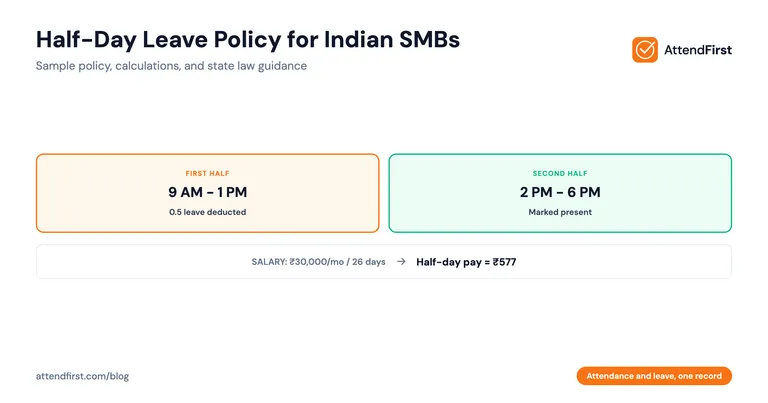
For a typical 9 AM-6 PM shift with a 1 PM lunch, the first half is 9 AM-1 PM (4 hours) and the second half is 2 PM-6 PM (4 hours).
A half-day leave can be charged against any leave type: casual leave, sick leave, earned leave, or privilege leave. Your policy decides which types allow half-day. (Confused about CL vs SL? See sick leave vs casual leave in India.)
Why You Need a Written Half-Day Policy
Most small businesses don’t have a written half-day policy. They handle each case by memory and WhatsApp messages. This breaks down fast.
Here’s what goes wrong without a policy:
1. Disputes about who got approved. “Sir said it was fine over chai” isn’t a record. Employees and managers remember conversations differently. Without a written policy, you lose these arguments.
2. Disputes about what counts as a half-day. One employee leaves at 3 PM (6 hours in) and claims it’s a half-day. Another leaves at 11 AM (2 hours in) and claims the same. Which is right? Both, if there’s no rule.
3. Payroll errors. If your accountant doesn’t know a half-day was taken, the salary calculation is wrong. Repeat across 25 employees and you get payroll chaos.
4. Leave quota abuse. Without a half-day limit, some employees take 20 half-days and burn through their quota creatively.
5. Legal gaps under the Shops and Establishments Act. Most Indian states (Karnataka, Maharashtra, Tamil Nadu, Delhi, Telangana) require employers to maintain a written leave policy. A half-day clause should be part of it. For the broader leave-tracking setup, see our leave management software guide for Indian SMBs.
A 10-minute policy document fixes all five problems.
Sample Half-Day Leave Policy (Copy-Paste Ready)
Need a full leave policy and not just the half-day clause? Use our free leave policy generator - it produces a complete, printable document covering sick, casual, earned, and maternity leave aligned with the Shops & Establishments Act for your state.
Copy this half-day clause. Change the company name and numbers. Put it in your employee handbook and joining letter.
HALF-DAY LEAVE POLICY

1. DEFINITION
A half-day leave is a planned absence from half of the employee's
scheduled working day. The employee is paid for the half worked
and 0.5 days is deducted from the employee's leave balance.

2. WORKING DAY SPLIT
First half: Shift start to lunch break start.
Second half: Lunch break end to shift end.
For the standard 9:00 AM - 6:00 PM shift with a 1:00 PM - 2:00 PM lunch:
  - First half = 9:00 AM to 1:00 PM
  - Second half = 2:00 PM to 6:00 PM

3. ELIGIBLE LEAVE TYPES
Half-day leave can be charged against:
  - Casual Leave (CL)
  - Sick Leave (SL)
  - Earned Leave / Privilege Leave (EL/PL)
Half-day leave is NOT allowed against maternity, paternity, or
compensatory off leaves.

4. APPROVAL
All half-day leaves require written approval from the reporting manager.
Approval must be recorded in the company attendance app.
WhatsApp messages and verbal approvals are not valid records.

5. ADVANCE NOTICE
Half-day leave (planned): apply at least 1 working day in advance.
Half-day leave (emergency): apply by 10:00 AM on the day itself.

6. LIMITS
An employee may take a maximum of 6 half-day leaves per calendar year.
Half-days beyond 6 are converted to full-day leaves.

7. LATE ARRIVAL AND HALF-DAY
An employee arriving more than 4 hours late without prior approval
will be marked as second-half present (and first-half leave will be
deducted). This is not a substitute for applying for a half-day.

8. PAYROLL IMPACT
Half-day leave: 50% of the daily wage paid.
Unpaid half-day leave: 0% of the daily wage paid (charged as LOP).

9. REVIEW
This policy will be reviewed annually and updated as needed.
Put this in your employee handbook. Have new joiners sign it. Store it in the attendance app so there’s a timestamped version of record.
Put attendance and leave in one record → Half-day leave tracking, manager approval, and payroll-ready exports included.
How to Track Half-Day Leave
Tracking half-day is where most SMBs go wrong. Here are the three common approaches, from worst to best.
Approach 1: Excel Sheet (Don’t Do This)
You maintain a sheet with employee names, dates, leave type, and a “half-day” column. Every manager updates it.
Why it fails:
- No audit trail
- Anyone can edit past entries
- Managers forget to update it
- Payroll gets the wrong numbers
- Disputes become your-word-vs-mine
Approach 2: Paper Leave Forms
Employees fill a leave form. Manager signs it. You file the form.
Why it’s better than Excel:
- There’s a signature trail
- Forms are harder to backdate
Why it’s still bad:
- Forms get lost
- Quarterly quota tracking requires manual counting
- No reminders or workflow
- Employees never know their current balance
Approach 3: Attendance App with Half-Day Support
Employees apply for half-day in the app. Manager approves with one tap. The app deducts 0.5 from the balance automatically and sends the data to payroll.
Why it wins:
- Every action timestamped
- Manager sees pending requests in one place
- Employees see their balance live
- Payroll exports are automatic
- No disputes about “did I get approval”
Good attendance apps in India support half-day tracking out of the box - an approved half day shows as HD in the daily attendance report instead of a full absence. AttendFirst does. So do greytHR’s paid plans and Keka. Most free plans of HR tools skip half-day support, so check before committing.
How AttendFirst Handles Half-Day Leave
Here’s how the flow works in AttendFirst, so you can compare to whatever tool you’re evaluating.
Employee side:
- Open the app. Tap “Apply Leave.”
- Select leave type: CL, SL, or EL.
- Select date and choose “Half-day.”
- Pick first half or second half.
- Add a reason (optional).
- Submit.
Manager side:
- Notification arrives: “Ramesh applied for CL half-day on 25 Apr (PM).”
- Open the app. See the request.
- Approve or reject with a note.
- Employee gets a notification.
Owner side:
- View the dashboard. See all leave balances.
- Half-day leaves show as 0.5 in the quota.
- Export to Excel for payroll at month-end.
- Everything timestamped, everything auditable.
This is not magic. Any modern attendance app should do this. The difference is whether it’s included in the free plan or hidden behind a paid tier.
State-Specific Legal Context
Leave rules in India vary by state under the Shops and Establishments Act. Here’s the quick version for the main states.
Karnataka: The Karnataka Shops and Commercial Establishments Act mandates at least 12 casual leaves, 12 sick leaves, and 15 earned leaves per year for permanent employees. Half-day is not explicitly defined in the Act - you set your own rule, but it must be in your written leave policy.
Maharashtra: The Maharashtra Shops and Establishments Act requires 21 paid leaves per year minimum. Employers must maintain a leave register showing balances and applications. Half-day policies must be written.
Tamil Nadu: The Tamil Nadu Shops and Establishments Act mandates 12 casual leaves and 12 sick leaves per year. A written leave policy is required for businesses with 10+ employees.
Delhi: The Delhi Shops and Establishments Act mandates 15 earned leaves, 12 casual leaves, and 12 sick leaves. Half-day policies fall under the employer’s discretion as long as they are written and fair.
Telangana, Andhra Pradesh: Similar structure: 12 CL, 12 SL, 15 EL. Written policies required.
Gujarat, Rajasthan, West Bengal: Each has its own version. Numbers vary by 1-3 days. Written policies required.
The common rule across all states: if you have 10+ employees, you need a written leave policy. Half-day is part of that. A court or labor officer can ask to see it.
Not legal advice, just a starting point. Check with a labor lawyer for your specific state and industry before finalizing the policy.
Common Mistakes with Half-Day Policy
1. Not writing it down. Unwritten policies don’t exist in court. Write it. Get it signed.
2. Allowing half-day on all leave types. Maternity leave as half-day makes no sense. Be clear about which types allow it.
3. No approval workflow. Half-day on request is the same as no policy. Require approval.
4. Not tracking the running balance. Employees should see their leave balance anytime. Surprises at year-end cause disputes.
5. Treating late arrivals as half-days without rules. If an employee comes in at 2 PM without asking, is that a half-day or a full absent? Pick one and put it in the policy.
6. No limit on half-days per year. Without a cap, some employees will take 30 half-days a year and exhaust the quota.
7. No payroll integration. If your attendance app doesn’t talk to payroll, you’ll recalculate salaries manually. Use an app that exports clean data.
Our Take
Half-day leave sounds like a small feature. It’s not. It’s the feature that decides whether your leave policy survives the first argument.
Most HR apps in India treat half-day as a pro-tier feature. greytHR’s free plan doesn’t include it. Kredily’s free plan doesn’t include it. PagarBook doesn’t include it. If you use any of those free plans, you’ll end up tracking half-days in a WhatsApp group.
We built AttendFirst’s free plan to include half-day tracking from day one, because we saw too many SMBs switch back to paper after realising their “free” HR tool didn’t support it.
Disclosure: We built AttendFirst. We’ve tried to be fair. If you’re already on a paid HR tool that handles half-day well, stick with it. If you’re on a free plan that doesn’t, switch.
FAQ
Is half-day leave mandatory in India?
No, half-day leave is not mandatory under any central law. But most Indian SMBs offer it because it helps employees handle doctor appointments, school events, and personal work without burning a full day. The Shops and Establishments Act of each state requires a written leave policy for employers with 10+ employees, and half-day rules should be part of that policy. Offering half-day leave is a retention and morale move, not a legal requirement.
How many half-day leaves should I allow per year?
Most companies allow 6-12 half-day leaves per year. This is enough for real needs like doctor visits and personal work without being abused. Any more than 12 starts creating attendance gaps. Set a hard cap in your policy and convert half-days beyond the cap to full days. In my experience across 34 small businesses, 6 half-days per year is the number that keeps both employees and employers happy.
Can an employee take a half-day leave on the same day?
Yes, but require notification by a fixed time - usually by 10 AM. Emergency half-days are valid for sick children, urgent appointments, or family issues. Planned half-days should require at least 1 working day of notice. Put both rules in your policy so there’s no confusion. Apps with a leave request feature make same-day applications easy, with manager notifications and one-tap approvals.
How do I calculate salary for a half-day leave?
If the half-day is paid, the employee receives 50% of the daily wage. If it’s unpaid (LOP), the employee receives 0% for that half. Daily wage is usually the monthly salary divided by working days in the month. For example: ₹30,000/month / 26 working days = ₹1,154/day. A paid half-day = ₹577, an unpaid half-day = ₹0 deducted. Good attendance apps export this calculation directly to your payroll.
What if an employee arrives 4 hours late without approval?
This is the most common edge case. Your policy should cover it. The standard rule: employees arriving more than 4 hours late without prior approval are marked as first-half absent (0.5 leave deducted) and second-half present. If the employee hasn’t applied for leave, the 0.5 is charged to their casual leave balance. This prevents the “I’ll just show up late whenever” pattern without being cruel to employees who had a genuine emergency.
Can I give half-day leave as compensation for overtime?
Yes, many companies do this. It’s called compensatory off (comp off). The rule: an employee who works on a weekly off or holiday earns 1 day of comp off, which they can use as two half-days or one full day. Put this in your policy explicitly. Don’t mix comp off with regular leave types - keep it separate in your tracking system so you know which half-days came from overtime and which came from the annual quota.
Does half-day leave count as a casual leave?
It depends on your policy. Most SMBs charge half-day against casual leave (CL) unless the employee explicitly chooses sick leave (SL) or earned leave (EL). Your policy should say which leave types allow half-day deductions. The cleanest rule: half-day is allowed against CL, SL, and EL, but not against maternity, paternity, or comp off. This is what I recommend.
Put attendance and leave in one record → Half-day leave support, manager approvals, and automatic payroll exports. Included in the free plan.
Ravi Shankar runs product at AttendFirst. He reviewed 12 leave policies from Indian SMBs before writing this guide and built AttendFirst’s leave module around what actually works for shop owners, small factories, and office teams of 10-75 people.
Frequently asked questions
Is half-day leave mandatory in India?
No, half-day leave is not mandatory under any central law. But most Indian SMBs offer it for doctor appointments and personal work without burning a full day. State Shops and Establishments Acts require a written leave policy for 10+ employees, and half-day rules should be part of it.
How many half-day leaves should I allow per year?
Most Indian SMBs allow 6-12 half-day leaves per year. Enough for real needs like doctor visits without being abused. Set a hard cap and convert half-days beyond the cap to full days. Six half-days per year is the number that keeps both employees and employers happy.
Can an employee take a half-day leave on the same day?
Yes, but require notification by a fixed time, usually 10 AM. Emergency half-days are valid for sick children, urgent appointments, or family issues. Planned half-days should require at least 1 working day of notice. Put both rules in your policy.
How do I calculate salary for a half-day leave?
If the half-day is paid, the employee receives 50% of the daily wage. Daily wage is the monthly salary divided by working days. Example: ₹30,000/month / 26 working days = ₹1,154/day. A paid half-day is ₹577. An unpaid half-day is ₹0 (marked as LOP).
What if an employee arrives 4 hours late without approval?
Your policy should cover it. Standard rule: employees arriving more than 4 hours late without approval are marked as first-half absent (0.5 leave deducted) and second-half present. If no leave has been applied, the 0.5 is charged to their casual leave balance.
Does half-day leave count as a casual leave?
It depends on your policy. Most SMBs charge half-day against casual leave unless the employee chooses sick leave or earned leave. The cleanest rule: half-day is allowed against CL, SL, and EL, but not against maternity, paternity, or comp off.
Get attendance tips for Indian businesses
One practical guide per week. No spam.
Put attendance and leave in one record
Indian holidays and weekly offs come already loaded. Setup takes 5 minutes, and no payment is required to start.