Sick Leave vs Casual Leave in India: The SMB Guide (2026)
Payal focuses on leave management and compliance workflows for Indian businesses.
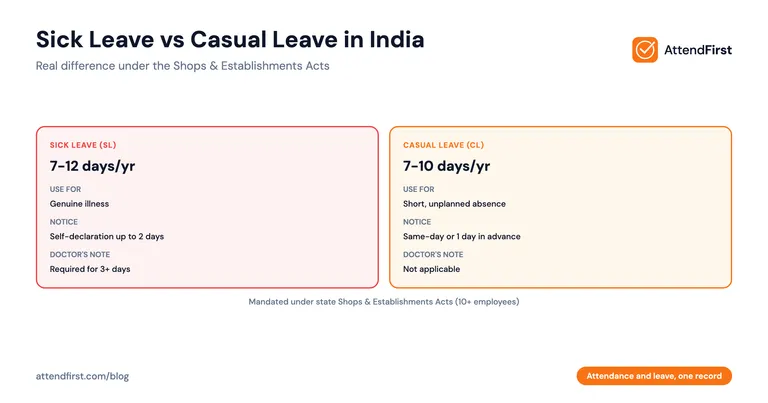
TL;DR: Sick leave (SL) is for illness with a doctor’s note. Casual leave (CL) is for short personal work without a reason. Privilege leave (PL) is earned, long, and often encashable.
- SL and CL are defined by state Shops & Establishments Acts, not one national rule
- Most Indian SMBs mix these up and face disputes at year-end
- Encashment rules differ: PL usually yes, CL usually no, SL varies
You run a 22-person trading firm in Coimbatore. An employee calls on Monday with fever. You mark it as CL. Next month he takes Friday off for a wedding. You mark that as SL “because CL is over.” At year-end, he asks why his PL balance is short. Now you have a dispute, no policy document, and three leave types mixed up in one Excel file.
This happens across Indian SMBs every month. The rules aren’t complicated, but nobody reads them. Here is what the law actually says, what most small businesses get wrong, and how to fix it without a full HR team.
Quick Comparison: PL vs SL vs CL
| Leave Type | Purpose | Typical Quota | Advance Notice | Doctor’s Note | Encashable? |
|---|---|---|---|---|---|
| Privilege / Earned (PL) | Planned time off, vacation | 12-21 days/yr | Yes (1-2 weeks) | No | Usually yes |
| Sick Leave (SL) | Illness, medical appointments | 7-12 days/yr | As soon as possible | Often yes (>2 days) | State-dependent |
| Casual Leave (CL) | Short personal work, emergencies | 7-12 days/yr | 1 day or same day | No | Usually no |
These quotas come from state Shops & Establishments Acts. The exact numbers vary. The rules for carry-forward and encashment vary more.
The Actual Difference (State-Specific)
There is no single national law that says “sick leave means X days.” India’s leave rules come from two places:
- Shops & Establishments Act: a separate Act for each state (Tamil Nadu, Maharashtra, Karnataka, Delhi, Gujarat, etc.). This is what applies to most SMBs: shops, offices, retail chains, clinics, restaurants.
- Occupational Safety, Health and Working Conditions Code, 2020: applies to factories and to several other categories of establishment. This one is national. It replaced the Factories Act 1948 on 21 November 2025, when the four labour codes came into force.
Here is the quick state-by-state picture for SL and CL under Shops & Establishments Acts:
| State | Sick Leave | Casual Leave | Privilege Leave |
|---|---|---|---|
| Tamil Nadu | 12 days/year | 12 days/year | 12 days/year (after 1 yr) |
| Karnataka | 12 days/year | Combined with SL | 1 day per 20 worked |
| Maharashtra | 8 days/year | Combined with SL | 21 days/year |
| Delhi | 12 days/year (combined SL+CL) | Combined with SL | 15 days/year |
| Gujarat | 7 days/year | 7 days/year | 21 days/year |
| Telangana | 12 days/year (combined SL+CL) | Combined with SL | 15 days/year |
Notice the pattern. Several states (Maharashtra, Delhi, Karnataka, Telangana) merge SL and CL into one combined category. Tamil Nadu and Gujarat keep them separate. You must check your own state Act before writing a leave policy.
The OSH Code (which replaced the Factories Act 1948)
For registered factories, annual leave with wages accrues at 1 day for every 20 days worked by an adult worker (1 day per 15 days for an adolescent worker, or a worker employed below ground in a mine). The Code does not define “sick leave” or “casual leave” separately. Those come from state rules or company policy.
What changed in 2025. The Factories Act 1948 was repealed on 21 November 2025 and its provisions moved into the Occupational Safety, Health and Working Conditions Code, 2020. The accrual rate above is unchanged. The eligibility threshold is not: a worker used to need 240 days of work in a calendar year to qualify, and under the OSH Code the threshold is 180 days. Carry-forward is capped at 30 days, with the excess encashed at year end. If your policy still says 240 days, it understates what your staff are entitled to. See attendance registers under the labour codes for the full picture.
Your state Shops and Establishments Act was not part of that consolidation and continues to apply unchanged. For most shops, offices, clinics, and restaurants, it is still the law that sets sick and casual leave.
Sick Leave under ESI
If your company is registered under ESI (Employees’ State Insurance), sick workers can claim ESI sick benefit for up to 91 days in a year at about 70% of wages. The scheme now runs under the Code on Social Security 2020, which absorbed the ESI Act 1948 in November 2025; the benefit itself is unchanged. This is separate from company SL. Workers earning under ₹21,000/month are covered.
What Indian SMBs Usually Get Wrong
Over five years of watching SMB owners handle leave, the same six mistakes show up.
Mistake 1: Using One Bucket for Everything
Owner gives “15 days leave.” No SL, no CL, no PL. Employee takes 15 days straight. At year-end, the owner wants to deduct for sickness too. Argument starts.
Fix: Split into at least two types: PL (planned) and SL/CL (unplanned). Write it down.
Mistake 2: No Written Policy
The policy lives in the owner’s head. Different employees hear different rules. New joiners get told one thing, old employees get another.
Fix: One-page written policy. Signed by every employee at joining.
Mistake 3: Carry-Forward Confusion
Owner says “leave expires December 31.” Employee says “I didn’t use my PL because of your deadlines, you should carry it forward.” No written rule. Dispute.
Fix: State carry-forward rules clearly. Maximum carry-forward days. Whether SL/CL carry forward (usually no).
Mistake 4: Mixing SL with Absent
Employee is sick for 3 days. Owner marks “absent.” Salary gets deducted. Employee discovers later that SL exists. Loses trust.
Fix: If SL quota is available, apply it automatically. Don’t deduct salary until SL is exhausted.
Mistake 5: No Doctor’s Note Policy
Owner asks for a doctor’s note every time. Employee says “it was just a fever, I didn’t go to a doctor.” Owner rejects the SL. Argument.
Fix: Most policies require a doctor’s note only for SL longer than 2 days. For 1-2 day sick leave, self-declaration works.
Mistake 6: Encashing CL at Year-End
Employee didn’t use any CL. Demands encashment. Owner pays. Next year, every employee demands CL encashment.
Fix: CL is use-it-or-lose-it. It is meant for unplanned short absences, not for cash. Write this in the policy.
Sample Sick Leave Policy (for an SMB)
Don’t want to write the whole policy from scratch? Generate one in 60 seconds with our free leave policy generator - it produces a printable, statute-aligned document with sick, casual, and earned leave sections customised to your state.
You can also copy the section below and adapt it. Replace state and numbers based on your Shops & Establishments Act.
Sick Leave Policy
- Employees are entitled to 12 days of sick leave per calendar year, pro-rated for mid-year joiners.
- Sick leave may be taken in half-day or full-day units.
- Employees must inform their manager before shift start on the day of illness, by phone or WhatsApp.
- For sick leave of 3 days or more, a doctor’s certificate is required before rejoining duty.
- Unused sick leave does not carry forward to the next year and is not encashable.
- Sick leave cannot be combined with casual leave or privilege leave without management approval.
- Employees registered under ESI must consult the ESI hospital; company sick leave covers the waiting period.
Sample Casual Leave Policy
Casual Leave Policy
- Employees are entitled to 8 days of casual leave per calendar year, pro-rated for mid-year joiners.
- Casual leave should be applied at least 1 day in advance except for genuine emergencies.
- Casual leave can be taken in half-day or full-day units, maximum 2 consecutive days at a time.
- Casual leave cannot be combined with sick leave or privilege leave except with prior approval.
- Unused casual leave does not carry forward to the next year and is not encashable.
- Casual leave sanctioning is at the manager’s discretion based on workload.
- Unauthorised casual leave (not informed or not approved) will be treated as leave without pay.
Keep both policies on one sheet. Get each employee to sign on joining.
Put attendance and leave in one record → Track PL, SL, and CL separately with auto-computed balance, manager approval, and mid-year pro-rated quotas. No Excel, no WhatsApp confusion. Start free
How to Track SL and CL Separately
This is where most SMBs fall apart. Excel works until you add half-days, mid-year joiners, and carry-forward rules. Then the formulas break.
What You Need to Track Per Employee
- Annual entitlement per leave type (PL, SL, CL)
- Pro-rated balance if joined mid-year
- Days used by type
- Days pending (requested but not yet approved)
- Days remaining by type
- Working day adjustment (weekends and holidays excluded from leave count)
Why Excel Fails
A garment factory in Tirupur with 40 workers tried running everything in one Excel file. Three months in, the PL column was linked to CL by a stray formula. Two employees got the wrong balance. One quit over it.
Excel doesn’t track:
- Half-day leave as 0.5 days correctly across formulas
- Pro-rated quota for a worker who joined in August
- Approval status (pending vs approved vs rejected)
- Manager approval chain
- Who requested, when, and why
The Right Approach
Use a leave management tool that has:
- Separate leave types configured with quotas
- Manager approval workflow with notifications
- Auto-computed balance that updates on approval
- Pro-rated quotas for mid-year joiners
- Half-day support
- Calendar-year or financial-year reset
- Export to Excel for salary processing
- Approved leave reflected automatically in the daily attendance report (on leave, not absent)
AttendFirst’s leave management handles all of this in the free plan for up to 3 employees.
When to Allow Encashment
Encashment is paying cash in place of unused leave. The rules are different for each leave type.
Privilege Leave: Usually Yes
PL is earned through work. Most companies allow encashment of unused PL at year-end or on exit. Many state Shops & Establishments Acts require PL encashment on separation.
Typical rule: Up to 30 days of PL encashable at year-end or on exit, paid at basic salary rate.
Casual Leave: Usually No
CL is for short, unplanned absences. It is meant to be used, not saved. Most SMBs don’t allow CL encashment because it encourages employees to not take short breaks, leading to burnout.
Typical rule: CL lapses at year-end. Not encashable.
Sick Leave: State-Dependent
SL encashment varies. Some state Acts allow it, others don’t. For companies under ESI, ESI sick benefit partially replaces SL encashment because workers already get cash benefit when sick.
Typical rule: SL isn’t encashable during service. On exit, follow state rules. Most SMBs don’t encash SL.
Maternity and Other Statutory Leave
Maternity leave (26 weeks under the Maternity Benefit Act for establishments with 10+ employees), paternity leave, and bereavement leave are separate and not related to PL/SL/CL quotas.
Real Workflow: A 28-Employee Clinic in Pune
A dental clinic chain in Pune runs 3 branches with 28 total staff: dentists, assistants, receptionists, and housekeeping. They used to track leave on a shared Google Sheet. Every year there was a dispute.
The problem:
- One dentist insisted her SL was 15 days, not 12. She had seen a different version of the sheet 6 months ago.
- A receptionist took CL for her brother’s wedding. Owner marked it as PL because “weddings are planned.” Dispute.
- A housekeeping staff member used 8 days of SL without any doctor’s note. Owner wanted proof, staff member refused. Dispute.
The fix:
- Owner wrote a one-page policy: 12 PL + 12 SL + 8 CL, doctor’s note required for SL >2 days, CL for emergencies only, all three leave types tracked separately.
- Every employee signed the policy. One copy in the HR file, one with the employee.
- Switched from Google Sheet to a leave management tool with separate PL/SL/CL balance and manager approval.
- Pro-rated quotas for mid-year joiners (e.g., a hygienist who joined in August gets 5 PL, 5 SL, 3 CL for that calendar year).
The result: Zero disputes for the following year. Monthly salary run takes 20 minutes instead of 2 hours.
Common Questions from SMB Owners
Is sick leave mandatory in India?
It depends on your state and establishment type. Under most state Shops & Establishments Acts, SL is mandatory with a minimum quota (usually 7-12 days/year). Under the OSH Code 2020, which replaced the Factories Act 1948 in November 2025, annual leave with wages is mandatory but SL isn’t separately defined, though most factory settlements include it. If you have 10+ employees, assume SL is mandatory and provide at least 7-12 days per year.
Can I combine sick leave and casual leave into one bucket?
Yes, and several states (Maharashtra, Delhi, Karnataka, Telangana) already do this in their Shops & Establishments Acts. If you combine them, provide a higher total (12-15 days) and drop the doctor’s note rule for short absences. The downside is that employees who are genuinely sick use the same bucket as those taking short personal breaks, which can cause unfairness. Most SMBs keep them separate for clarity.
Do I need a doctor’s note for 1 day of sick leave?
Most policies don’t require a doctor’s note for sick leave of 1-2 days. Self-declaration is enough. For sick leave of 3 or more days, a doctor’s note is standard practice. Asking for a doctor’s note for every single day of fever is unreasonable and creates friction with employees.
What if an employee runs out of sick leave but is genuinely ill?
You have three options. First, allow the employee to use PL or CL to cover the sickness. Second, allow leave without pay for the extra days. Third, if the employee is registered under ESI, direct them to claim ESI sick benefit (up to 91 days at ~70% of wages). Never force a sick employee to come to work. It affects team productivity and your legal standing if the illness is contagious.
Can casual leave be taken for 5 continuous days?
Most policies limit CL to 2-3 consecutive days. CL is meant for short, unplanned absences. For longer planned time off, employees should use PL. If an employee wants 5 days off for a family function, that should be PL with advance notice, not CL. Write this rule into your policy so there is no ambiguity.
Is leave encashment taxable in India?
Yes. Leave encashment received during employment is fully taxable as salary. Leave encashment at retirement or resignation has partial tax exemption under Section 10(10AA) of the Income Tax Act, up to ₹25 lakhs (as of Budget 2023) for non-government employees. Check the current exemption limit before year-end encashment.
What happens to unused leave when an employee leaves the company?
For PL, most companies pay encashment for unused days as part of full and final settlement. Some state Acts make this mandatory. For SL and CL, the general rule is that they lapse on exit, no encashment. The exact rule should be written in your leave policy and employment contract. If it isn’t written, you may be forced to pay under state labour rules.
Setup Checklist
Before your next policy review, tick these off:
- Check your state Shops & Establishments Act for minimum SL/CL quotas
- Write a one-page leave policy with PL, SL, CL separately
- Define advance notice rules, doctor’s note rules, and encashment rules
- Get every employee to sign the policy at joining
- Stop tracking leave on WhatsApp. Move to a leave management tool
- Configure pro-rated quotas for mid-year joiners
- Set up manager approval workflow
- Review the policy every January
Stop mixing SL, CL, and PL in one Excel column. Put attendance and leave in one record → Separate leave types, auto-computed balance, manager approval in one tap, pro-rated for mid-year joiners. Works for clinics, retail, factories, and offices across India.
Payal Sharma works in field operations with Indian SMBs across Tirupur, Pune, and Bangalore. Her focus for this post: why so many owners still mix SL, CL, and PL into a single Excel column, and how a clean leave policy prevents the most common month-end disputes.
Frequently asked questions
Is sick leave mandatory in India?
It depends on state and establishment type. Under most state Shops and Establishments Acts, SL is mandatory with a minimum quota (usually 7-12 days/year). Under the Occupational Safety, Health and Working Conditions Code 2020, which replaced the Factories Act 1948 on 21 November 2025, annual leave with wages is mandatory but SL is not separately defined. If you have 10+ employees, assume SL is mandatory and provide at least 7-12 days/year.
Can I combine sick leave and casual leave into one bucket?
Yes. Maharashtra, Delhi, Karnataka, and Telangana already do this in their Shops and Establishments Acts. If you combine them, provide a higher total (12-15 days) and drop the doctor's note rule for short absences. Most SMBs keep them separate for clarity and fairness.
Do I need a doctor's note for 1 day of sick leave?
No. Most policies do not require a doctor's note for sick leave of 1-2 days - self-declaration is enough. For sick leave of 3 or more days, a doctor's note is standard practice. Asking for a doctor's note for every single day creates friction with employees.
What if an employee runs out of sick leave but is genuinely ill?
Three options: (1) let the employee use PL or CL to cover the sickness, (2) allow leave without pay for extra days, or (3) direct ESI-registered employees to claim ESI sick benefit (up to 91 days at about 70% of wages). Never force a sick employee to come to work.
Can casual leave be taken for 5 continuous days?
Most policies limit CL to 2-3 consecutive days. CL is meant for short, unplanned absences. For 5 days off for a family function, employees should use PL with advance notice, not CL. Write this rule into your policy.
What happens to unused leave when an employee leaves the company?
For PL, most companies pay encashment for unused days in full and final settlement - some state Acts make this mandatory. For SL and CL, the general rule is they lapse on exit, no encashment. The exact rule should be in your leave policy and employment contract.
Get attendance tips for Indian businesses
One practical guide per week. No spam.
Put attendance and leave in one record
Indian holidays and weekly offs come already loaded. Setup takes 5 minutes, and no payment is required to start.