Biometric Attendance Machine Price in India (2026 Guide)
Arjun researches attendance, leave, and workforce trends for Indian small businesses. He writes data-driven comparisons and guides.
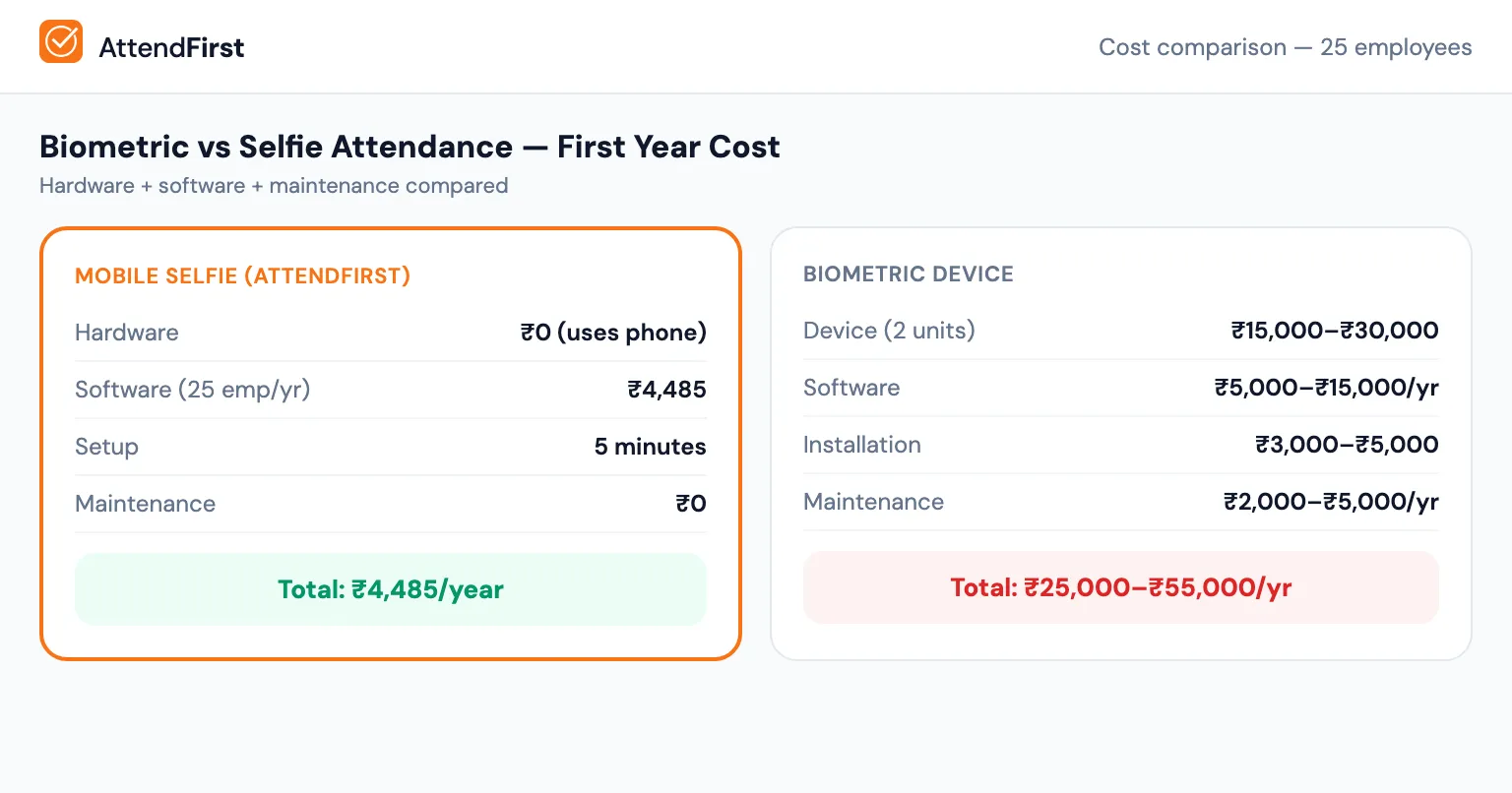
A biometric attendance machine in India costs ₹3,000 to ₹25,000 upfront depending on sensor type, plus ₹1,500 to ₹10,000 per year in annual maintenance, cabling, and enrollment time. For most small Indian businesses with under 25 employees, the three-year total cost of ownership runs ₹18,000 to ₹55,000 per gate, which is substantially higher than a modern phone-based attendance app that does the same job without the hardware.
This post breaks down the real 2026 price ranges by sensor type, lists the hidden costs every vendor quote leaves out, and shows the TCO for a 20-person team. If you are shopping for a biometric device, read this first.
What a biometric attendance machine actually costs
Vendor listings show the sticker price. That number is usually 40-60% of what you will pay in year one. Here are realistic 2026 ranges across the four sensor types sold in India:
| Sensor type | Sticker price | Installation | Year 1 total |
|---|---|---|---|
| Fingerprint (basic) | ₹3,000-5,500 | ₹800-1,500 | ₹5,000-8,500 |
| Fingerprint (enterprise) | ₹6,500-12,000 | ₹1,500-3,000 | ₹9,500-17,000 |
| Face recognition (tablet-form) | ₹8,000-18,000 | ₹2,000-4,000 | ₹11,500-24,000 |
| Face recognition (wall-mounted) | ₹15,000-25,000 | ₹3,000-6,000 | ₹19,500-33,500 |
Prices are for a single-gate setup. Multi-gate or multi-branch buyers pay the per-unit price again, plus software to merge data across devices.
The hidden costs every vendor quote misses
Sticker price is the first line of the bill, not the last.
AMC (annual maintenance contract). Year two onwards, every biometric vendor charges ₹1,500-10,000 per device per year for firmware updates, sensor calibration, and break-fix. Skip the AMC and you pay per-visit when the machine dies.
Cabling and electrical. Ethernet or RS-485 cable to your network switch. Power outlet if none exists at the install point. Most vendors quote this as “site preparation” at ₹1,500-4,000 per machine.
Enrollment time. Every employee has to stand at the machine during first-time enrollment. 3-5 minutes per person for a fingerprint, 1-2 for face. A 50-person team loses 2-4 hours of work time on day one. Add another hour every time a new employee joins.
UPS or battery backup. Indian power cuts. ₹2,500-5,000 for a basic UPS so the machine does not miss check-ins during an outage.
Cloud sync software. Most mid-range biometric devices ship with Windows-only software that runs on a dedicated laptop. If you want cloud sync to see attendance from your phone, add ₹500-2,000 per month to the AMC.
Replacement of worn-out sensors. Fingerprint sensors degrade after 2-3 years of high-frequency use (manufacturing, retail, security). Replacement sensor or full unit swap: ₹2,000-6,000.
Migration cost when you move office. New cabling, new electrician, potential re-enrollment if the new site has different network topology.
Summed up, a ₹5,000 fingerprint machine advertised in a JustDial listing typically costs ₹8,000-12,000 in year one and another ₹3,000-6,000 every year after.
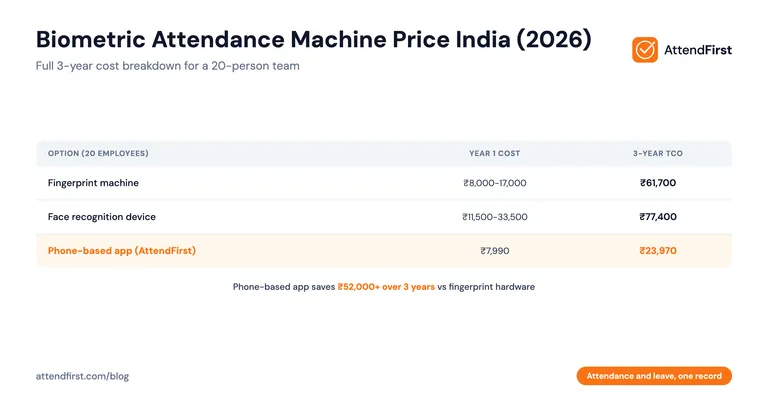
3-year TCO for a 20-person team (real math)
Take a 20-person office with one gate. Here is what each option actually costs over 3 years.
Option 1: Basic fingerprint machine
| Item | Cost |
|---|---|
| Device (mid-range fingerprint) | ₹8,000 |
| Installation + cabling + UPS | ₹5,500 |
| Enrollment time (20 x 4 min x ₹200/hr staff time) | ₹2,700 |
| AMC year 2 | ₹3,000 |
| AMC year 3 | ₹3,000 |
| Cloud sync software (3 years x ₹1,000/month avg) | ₹36,000 |
| Sensor swap mid-year 3 | ₹3,500 |
| 3-year total | ₹61,700 |
Option 2: Face recognition device
| Item | Cost |
|---|---|
| Device (wall-mounted face) | ₹20,000 |
| Installation + cabling + UPS | ₹8,000 |
| Enrollment time | ₹1,400 |
| AMC x 2 years | ₹12,000 |
| Cloud sync software (3 years) | ₹36,000 |
| 3-year total | ₹77,400 |
Option 3: Phone-based attendance app (QR + selfie + GPS)
| Item | Cost |
|---|---|
| Hardware | ₹0 |
| Installation | ₹0 |
| Enrollment (self-service via join link) | ₹0 |
| Software year 1 (₹3,000 for the first 10, then 10 x ₹499 = ₹7,990/year) | ₹7,990 |
| Software year 2 | ₹7,990 |
| Software year 3 | ₹7,990 |
| 3-year total | ₹7,990 x 3 |
The phone-based app is 64% cheaper than a basic fingerprint device and 71% cheaper than a face recognition machine for a 20-person team over 3 years.
When a biometric machine is still the right call
Honesty first: biometric hardware is not always the wrong choice. Here are the cases where it still makes sense:
- Shop floor with no phones allowed. Factory environments where phones are banned for safety or policy reasons. A wall-mounted face recognition unit works when a phone cannot.
- Extremely high throughput. 200+ employees clocking in within a 15-minute window. A QR kiosk can handle this with a tablet and rotating code, but a dedicated biometric device is slightly faster per scan.
- Compliance audit requires fingerprint logs. Some government contracts or export-oriented factories have audit clauses that mandate biometric fingerprint records. Read the contract; if fingerprint is named, buy the hardware.
- Phones are unreliable in the environment. Cold storage warehouses, wet food processing lines. Phones break or refuse to work. A sealed biometric unit does not.
If none of those apply, the hardware is convenience money, not necessity money.
The phone-based alternative, explained
A modern attendance app replaces the biometric machine with the phone every employee already owns. Three check-in methods cover every scenario a device handles:
- GPS check-in. The employee opens the app, taps Check In, and their location is captured silently. Works for field staff, delivery teams, and anyone not at a fixed gate. Location accuracy is within 10-30 meters outdoors.
- Selfie check-in. The camera opens, the employee takes a photo, and it is attached to the attendance record. Prevents buddy punching because you can see the face on every check-in. Same audit trail a face recognition device gives you, without the hardware.
- QR code check-in. Print a QR or display it on a spare tablet at the gate. Employees scan with their phone, tap Check In, done. No biometric enrollment, no sensor to clean. Read the QR attendance docs for the full setup.
Combined with a geofence (for GPS) and a rotating QR (for the kiosk), the phone-based approach gives you the same accountability as biometric hardware at a fraction of the cost.
What you lose by moving off biometric
Realistic view of the trade-offs:
- No dedicated scan hardware at the door. Employees pass through their phone, not a device. Some owners miss the physical ritual.
- You depend on the phone. If the phone battery is dead, the employee uses the QR kiosk instead. But if they forget the phone entirely, you need a fallback (admin backfill).
- No fingerprint-only audit logs. If your contract specifies fingerprint, an app cannot produce that format.
These trade-offs are real but minor for the 10 to 75-employee Indian SMB. The cost savings are not minor.
What you gain
The things biometric hardware cannot do at all:
- Multi-location with one dashboard. Branch in Hyderabad, site in Bangalore, sales team in Chennai, all in one view.
- Field staff verification. Real GPS coordinates for every check-in, with a map. A wall-mounted device cannot track a field engineer at a client office.
- Leave management in the same app. Approval flow, balances, org-wide calendar. Biometric software usually skips this or bundles it at extra cost.
- Excel reports in one click. Every month, no IT ticket.
- No capex. Free for up to 3 employees, ₹3,000/year for teams of 4 to 10, ₹499 per employee per year above 10. Cancel any time, export data.
Quick decision guide
- Under 25 employees, one or two locations, phones allowed: Phone-based app. Save ₹40,000-60,000 over 3 years.
- Under 25 employees, phones banned on the floor: Mid-range biometric face device. ₹20,000 upfront + ₹3,000/year AMC.
- 25-100 employees, multiple locations: Phone-based app with QR kiosk at fixed gates. A single biometric per gate is a nice-to-have, not a must.
- Factory, cold storage, high-risk environment: Wall-mounted biometric. No compromise.
- Audit/compliance mandate: Follow the contract.
For most Indian SMBs reading this, the first row is the answer.
Try the phone-based approach free
AttendFirst keeps attendance and leave in the same record, which is the part a machine at the gate cannot do at all. GPS, selfie, and QR check-in, leave requests and balances, Indian holidays pre-loaded, automatic daily attendance reports, and Excel export are on every plan, including the free one for up to 3 employees. Setup takes about 10 minutes.
Further reading: Selfie vs biometric attendance: the honest comparison and Best attendance app in India 2026 for how AttendFirst stacks up against the alternatives.
Frequently asked questions
How much does a biometric attendance machine cost in India in 2026?
Basic fingerprint machines run ₹3,000-5,500, enterprise fingerprint devices ₹6,500-12,000, tablet-form face recognition devices ₹8,000-18,000, and wall-mounted face recognition units ₹15,000-25,000. Add installation, cabling, and UPS backup (₹1,500-6,000) in year one, plus ₹1,500-10,000 per year in AMC from year two onwards. Prices are per gate - multi-gate or multi-branch deployments pay the per-unit price again for each location.
What are the hidden costs of a biometric attendance machine?
AMC from year two (₹1,500-10,000/year per device), cabling and electrical work (₹1,500-4,000 per machine), UPS backup for power cuts (₹2,500-5,000), cloud sync software if you want mobile dashboard access (₹500-2,000/month), sensor replacements every 2-3 years for high-use environments (₹2,000-6,000), and enrollment time (3-5 minutes per employee for fingerprint, 1-2 minutes for face). A ₹5,000 sticker-price machine typically costs ₹8,000-12,000 in year one and ₹3,000-6,000 every year after.
Is it cheaper to buy a biometric machine or use a phone-based attendance app?
For teams under 25 employees, a phone-based app is significantly cheaper over three years. A basic fingerprint machine for a 20-person office costs around Rs.61,700 over 3 years including AMC and cloud sync software; a phone-based app like AttendFirst costs ₹7,990/year for a 20-person office (billed annually), so over 3 years you pay that annual amount three times. The app also covers multi-location, field staff, leave management, and Excel export - which biometric machines either do not do or charge extra for.
When does it still make sense to buy a biometric attendance machine?
Biometric hardware is the right choice when shop floor policy bans personal phones (safety or security rules), extremely high throughput requires 200+ scans in a 15-minute window, the working environment is hostile to phones (wet food processing, cold storage, heavy dust), or a contract audit mandates fingerprint records. For the typical 10-75-employee Indian SMB with phones allowed on premises, those conditions rarely apply.
Can a phone-based attendance app replace a biometric machine's audit trail?
Yes for most use cases. A selfie photo plus GPS coordinates plus timestamp plus device fingerprint creates an audit trail at least as strong as a biometric fingerprint record. The exception is contracts that explicitly name fingerprint logs - read the contract; if fingerprint is specified, buy the hardware. Otherwise, timestamped photos with location are admissible for salary disputes, HR reviews, and typical compliance checks.
Get attendance tips for Indian businesses
One practical guide per week. No spam.
Put attendance and leave in one record
Indian holidays and weekly offs come already loaded. Setup takes 5 minutes, and no payment is required to start.