Buddy Punching in India: How SMBs Stop Attendance Fraud
Arjun researches attendance, leave, and workforce trends for Indian small businesses. He writes data-driven comparisons and guides.
TL;DR: Buddy punching, one employee marking attendance for an absent colleague, costs a typical 30-person Indian SMB around ₹27,000 per month. Registers and simple apps cannot stop it. GPS + selfie verification stops it cold because both location and identity must match.
- 5% buddy punching on 30 employees at ₹600/day = ₹27,000/month lost
- Registers make buddy punching trivial
- GPS alone fails to phone lending
- Selfie + GPS together closes the gap
What Is Buddy Punching?
Buddy punching is when one employee marks attendance on behalf of another who is absent, late, or leaving early. The covering employee signs, scans, or taps on behalf of their friend, and the records show the absent employee as present.
That small favour drains money from thousands of small businesses every month.
Here is a real pattern from a 25-person manufacturing SMB near Coimbatore. Two friends, Ravi and Suresh, had an arrangement. Whenever one was going to be late, the other would sign the register for both. Over 18 months, they each got an extra 42 “present” days credited to payroll. At ₹550 per day, that is ₹23,100 per person, ₹46,200 total, paid out for work that never happened.
The owner only caught it when a third employee mentioned it during an exit interview. By then, the money was gone.
This isn’t unusual. It happens every day, in every industry, at every size.
How Much Does Buddy Punching Cost Indian SMBs?
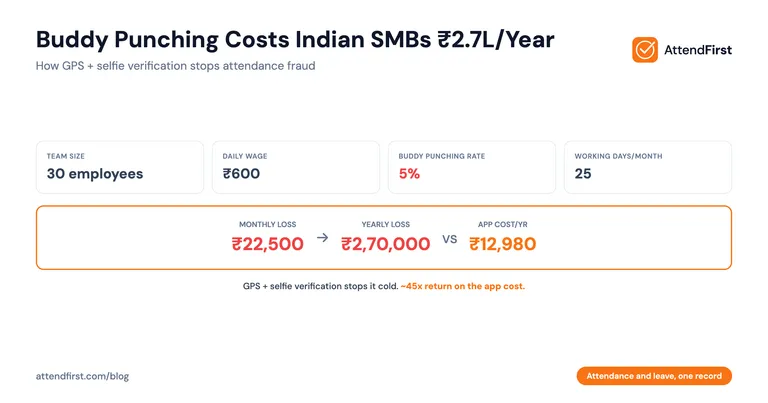
Here is the math for a typical 30-employee SMB.
Assumptions:
- 30 employees
- Average daily wage or salary equivalent: ₹600 per day
- Working days per month: 25
- Buddy punching rate: 5% of attendance records (industry estimates for paper-based systems in India range from 3% to 10%)
Calculation:
- Total person-days per month: 30 x 25 = 750
- Buddy punched days: 750 x 5% = 37.5 days
- Monthly cost: 37.5 x ₹600 = ₹22,500 per month
- Annual cost: ₹22,500 x 12 = ₹2,70,000 per year
For a bigger team of 50 employees at the same wage, the annual cost climbs to around ₹4,50,000. For a team with higher average wages (₹1,000 per day, common in Indian IT services), the 30-person number rises to ₹3,75,000 per year.
These are direct salary losses. They don’t include the indirect costs: missed work, broken trust, and the management time lost investigating disputes.
The 5% figure is conservative. Studies in the US (where buddy punching is well documented) put it between 7% and 15% in paper-based systems. Indian SMBs with informal registers are likely similar or worse.
Why Does the Register Enable Buddy Punching?
An attendance register is the most common attendance system in Indian SMBs. It is also the easiest to cheat - and whatever it says flows straight into the daily attendance report and, from there, into payroll.
Think about what a register requires to prevent buddy punching:
- The person signing must be the employee named on that row
- The signature must match their normal signature
- The manager or security guard must verify this for every signature
In practice, none of this happens. A single person sits at the reception with the register. Employees walk in, grab the pen, sign, and walk on. The receptionist doesn’t check signatures. Nobody has the time.
A friend covering for an absent colleague takes 3 seconds: grab the pen, sign both names, move on. The register has no way to detect this.
Other paper-based problems:
- No timestamp accuracy. Employees can sign at 10:00 AM but write 9:00 AM
- No location proof. The register could be carried to a tea shop and signed there
- No identity verification. Any human with a hand can make a mark
- No audit trail. Once ink hits paper, you can’t tell when or how it got there
Registers aren’t a security system. They are a ritual that feels like one.
Why Don’t Simple Apps Stop Buddy Punching?
Some SMB owners upgrade from paper to a basic attendance app and assume the problem is solved. It usually isn’t, if the app doesn’t verify identity.
The weakness depends on what the app verifies:
Apps with just a login. If the employee just logs in with a username and password, the password can be shared. The friend logs in on their own phone and marks the absent employee present. No physical presence needed.
Apps with just GPS. GPS proves a phone was at the work location, not that the right person held the phone. A friend can carry both phones to the office and tap check-in on both. GPS says both phones were present. Neither phone says anything about who was holding them. (See GPS attendance for small businesses for what GPS does and doesn’t catch.)
Apps with just a PIN code. PINs get shared. Sticky notes, WhatsApp messages, whispered over chai. Once the PIN leaks, attendance is meaningless.
Apps with just face recognition but no liveness check. Some cheap face apps accept a printed photo of the employee’s face. A friend tapes the photo to the camera and checks in.
The gap in all of these is the same: identity isn’t verified against the physical person at the moment of check-in.
How Does GPS + Selfie Verification Stop Buddy Punching?
This is where a properly designed attendance app closes the gap.
When an employee taps “Check In” on an app like AttendFirst, two things happen simultaneously:
- The phone’s GPS captures the current location
- The phone’s front camera captures a selfie
Both pieces of data are sent to the server together, timestamped. The manager sees them side by side on the dashboard.
For a buddy to cheat this system, they would need to:
- Be physically at the work location (GPS check)
- Have the absent employee’s face in front of the camera (selfie check)
The friend can’t satisfy both at once. If they are at the office with their own phone, the selfie shows their face, not the absent employee’s. If they have the absent employee’s phone, the GPS shows the office, but the selfie still shows the friend’s face.
For the fraud to work, the absent employee would have to be physically at the office. At which point they aren’t absent, so there is nothing to cover up.
This is what makes GPS + selfie much stronger than either method alone. You need both identity and location at the same moment. Buddy punching becomes effectively impossible on a well-designed system. For a longer comparison of selfie verification against fingerprint biometrics, see biometric vs selfie attendance.
Other Attendance Fraud Patterns You Should Know
Buddy punching is the most common, but it isn’t the only way employees cheat attendance. Here are the other patterns to watch for.
Proxy QR Code Scanning
Some offices print a QR code at the entrance for employees to scan. The shortcut: take a photo of the QR code, share it on WhatsApp, and employees scan it from anywhere. Suddenly everyone is “at the office” from their homes.
Defence: Use dynamic QR codes that change every 30-60 seconds, or combine QR with selfie verification. The code is useless without a live photo at the actual location. (Full QR code attendance setup guide.)
Fake GPS Apps
Android has apps that let users set a fake GPS location. An employee can spoof their GPS to show the office while sitting at home.
Defence: A selfie adds a second factor the fake GPS app can’t override. The combination is what matters. Some apps also detect developer mode or common spoofing apps and block check-in, though this creates friction and isn’t always reliable.
Clock-In-Then-Leave
An employee shows up, checks in at 9:00 AM, then quietly leaves for 3 hours to run personal errands, and returns to check out at 6:00 PM.
Defence: Mandatory check-out at specific intervals, or mid-day verification. Most owners don’t do this because it creates surveillance friction, and the fix is usually a performance conversation, not a technical one.
Group Check-In at the Gate
An employee arrives at the office gate, takes a selfie in the parking lot, then gets back on their bike and leaves. Technically they were at the office. Technically they checked in.
Defence: Geofencing that triggers a forced check-out if the phone leaves the work location before end-of-day. Few apps do this well. Again, this is usually a management issue surfaced by a data pattern, not a technical lock.
Manager Collusion
An employee asks the manager to mark them present for days they didn’t work. This one no attendance tool can fix because the trusted person is the cheater.
Defence: Audit trails showing which manager marked which employees, and owner-level review of manual entries. If one manager adds suspicious numbers of manual entries, investigate.
The first three (proxy QR, fake GPS, fake selfie) are the only ones a good attendance app can defend against. The rest are management and culture issues.
What to Check This Week If You Suspect Buddy Punching
If you are reading this and wondering whether it is happening in your team, here is a 5-step check you can run this week without any tool upgrade.
Step 1: Pick the Last 30 Days of Attendance Records
Pull your attendance data for the last 30 days. Register, Excel, or app, whatever you use.
Step 2: Look for Pattern Clusters
Sort employees by attendance rate. Look for clusters of employees with identical patterns. If Ravi and Suresh both have exactly 26 present days last month with the same leaves on the same dates, that is suspicious. Real independent people have slightly different patterns.
Step 3: Check for “Impossible” Entries
Look for any day where an employee was marked present but you have other evidence they weren’t. Phone records, WhatsApp messages, email timestamps, a comment from a colleague. Even one “impossible” entry proves the fraud exists somewhere.
Step 4: Ask the Supervisor Quietly
Your shop floor supervisor or office manager knows more than you think. Ask them in a private conversation: “Between us, have you seen anyone signing for someone else?” If they hesitate, you have your answer.
Step 5: Run a Spot Check
Pick a random morning next week. At 9:30 AM, walk through the office yourself and mentally list who is physically present. Compare to the attendance record at end of day. If the records show 28 present and you only counted 25 at 9:30, three of those “present” people showed up an hour late or never. That is your baseline for investigation.
If step 5 shows any gap, buddy punching is almost certainly happening. The exact scale depends on the size of the gap.
How to Fix It: 3-Week Plan
Once you have confirmed buddy punching, here is how to fix it without blowing up team morale.
Week 1: Acknowledge quietly. Don’t call out specific employees yet. Announce that attendance tracking is moving to a new system for “accuracy and payroll reasons.” Keep it factual. Everyone will know why, but nobody loses face.
Week 2: Install GPS + selfie attendance. Pick an app that supports both. AttendFirst has GPS, selfie, and QR code check-in built in and is free for up to 3 employees. Set up the system, add employees, run a 5-day pilot with the whole team in parallel with the old register.
Week 3: Remove the old register. After the pilot, stop accepting paper entries. All attendance goes through the app. Watch the first week’s data carefully. You will see who used to buddy punch, because their attendance rate will drop. Sometimes by 15-20%.
Don’t fire anyone in the first month. Let them adjust. Most employees will quietly come back to full attendance once the system is fair. Employees who were chronically absent will self-identify and are a separate performance issue.
What Changes After You Stop Buddy Punching?
Here is what typically changes in the first 60 days after a GPS + selfie system goes live.
Payroll accuracy improves immediately. Your monthly wage bill drops by the buddy punching cost. For a 30-person SMB, that is ₹20,000-30,000 per month back in the business.
Some employees will complain. They will say the new system is “too strict” or “distrusting.” These are usually the beneficiaries of the old system. Hold the line. Employees who never cheated won’t mind a 10-second check-in.
Genuine absence patterns become visible. You will see which employees are chronically late or absent. Now you can have real performance conversations based on data, not guesses.
The total savings typically pay for the app ten times over in the first month alone.
Cost of Doing Nothing vs Fixing It
Let me put the numbers side by side.
| Option | Annual Cost |
|---|---|
| Keep register | ₹2,70,000 in buddy punching |
| AttendFirst (30 employees) | ₹12,980 |
| Net savings with app | ₹2,70,000 minus ₹12,980 |
That is a 45x return on the attendance app cost in the first year. And that is before counting the manager time saved on monthly attendance compilation, the avoided disputes, and the reduced payroll errors.
For any SMB that suspects even a small amount of buddy punching, the math isn’t close.
FAQ
How common is buddy punching in Indian SMBs?
Estimates vary, but 3-10% of attendance records in paper-based Indian SMBs involve some form of buddy punching. The rate tends to be higher in labour-intensive businesses (construction, manufacturing, security services) and lower in professional offices where everyone sees each other at their desks. A 5% baseline is a reasonable estimate for most small businesses, which makes buddy punching a roughly ₹22,000/month problem on a 30-person team at ₹600/day wages.
Can GPS alone stop buddy punching?
No. GPS alone proves a phone was at the work location. It doesn’t prove who was holding the phone. An employee can bring two phones to the office and check in on both. To stop buddy punching, you need GPS plus a second factor that verifies identity at the moment of check-in. A selfie taken by the phone’s front camera is the simplest and most effective second factor for Indian SMBs.
What if an employee covers their face during the selfie check-in?
A good attendance app rejects selfies where the face isn’t clearly visible. The manager can also see all selfies in the dashboard and flag bad ones for resubmission. On a small team, an employee who consistently submits blurry or covered selfies will be noticed within a week. This isn’t a serious loophole in practice.
Is selfie attendance legal in India?
Yes, with employee consent. You must inform employees that the system captures their photo at check-in, how the photo is stored, who can see it, and for how long. Under India’s DPDP Act 2023, this counts as processing personal data and requires a clear privacy notice. Most attendance apps provide template consent language. Treat it like any other employment document and keep signed copies.
How does buddy punching compare to time theft in general?
Buddy punching is one form of time theft. Others include long breaks, personal phone use, late arrivals marked as on-time, and early departures marked as full days. Buddy punching is the easiest to measure and fix because it has a clear digital defence. The other forms need management attention and culture changes. Start with buddy punching because it gives the fastest payback, then address the softer patterns.
Will employees quit if I introduce strict attendance tracking?
A few might, and those are almost always the employees who were benefiting from the old loose system. Most genuine employees don’t mind checking in properly, especially when you explain why. Frame it as fairness: “this makes sure everyone gets paid accurately for the days they worked.” Employees who cheat feel watched. Employees who don’t cheat feel protected.
Can I prosecute an employee for buddy punching?
Legally, buddy punching is a form of fraud and breach of employment contract. In practice, prosecution is rare in India because the amounts per individual are modest and the process is slow. The practical response is to document the incidents, have a conversation with the employee, and in serious cases, terminate with cause. Keep the audit trail from the new attendance system because it becomes evidence if the employee later disputes termination.
Does AttendFirst prevent buddy punching?
Yes. AttendFirst captures GPS and selfie together at every check-in and check-out. Both must match for the record to be valid. The manager can view every selfie and GPS coordinate in the dashboard. This combination makes buddy punching practically impossible without the absent employee being at the work location, which defeats the purpose of the fraud. AttendFirst is free for up to 3 employees, ₹3,000/year for teams of 4 to 10, and ₹499 per employee per year above 10, making it the cheapest buddy-punching defence available in India.
Arjun Desai writes on attendance fraud and verification for AttendFirst, where attendance and leave live in one record. He has watched buddy punching drain lakhs from Indian SMBs and wrote this guide to help owners see what is happening and fix it fast.
Stop buddy punching today - AttendFirst pairs GPS and selfie check-in with leave in the same record, so a “he was on leave” claim can be checked against the same screen. Teams up to 10 pay ₹3,000/year, ₹499 per employee per year above that, and up to 3 employees costs nothing. No hardware and no contracts.
Frequently asked questions
How common is buddy punching in Indian SMBs?
Estimates put 3-10% of attendance records in paper-based Indian SMBs as some form of buddy punching. 5% is a reasonable baseline. On a 30-person team at ₹600/day wages, that is roughly ₹22,500/month in payroll loss.
Can GPS alone stop buddy punching?
No. GPS proves a phone was at the work location but not who was holding it. An employee can bring two phones to the office and check in on both. To stop buddy punching, you need GPS plus a second identity factor. A selfie at check-in is the simplest effective option.
Is selfie attendance legal in India?
Yes, with employee consent. Under the DPDP Act 2023, capturing an employee photo at check-in counts as processing personal data. You must inform employees that their photo is captured, how it is stored, and for how long. Most attendance apps provide template consent language.
What if an employee covers their face during the selfie check-in?
A good attendance app rejects selfies where the face is not clearly visible. Managers can view all selfies on the dashboard and flag bad ones for resubmission. On small teams, anyone consistently submitting blurry or covered selfies is noticed within a week.
Will employees quit if I introduce strict attendance tracking?
A few might, and they are usually the ones who benefited from the old loose system. Most genuine employees do not mind checking in properly, especially when framed as fairness: accurate pay for days actually worked. Employees who cheat feel watched. Employees who do not cheat feel protected.
How much does stopping buddy punching actually save?
For a 30-employee SMB at ₹600/day wages with 5% buddy punching, the monthly loss is about ₹22,500 or ₹2,70,000/year. An attendance app for 30 employees costs ₹12,980/year (₹3,000 for the first 10, then 20 x ₹499 = ₹12,980/year). Net savings are ₹2,70,000 minus ₹12,980/year - the app pays for itself many times over.
Get attendance tips for Indian businesses
One practical guide per week. No spam.
Put attendance and leave in one record
Indian holidays and weekly offs come already loaded. Setup takes 5 minutes, and no payment is required to start.