Attendance Registers Under the Labour Codes: What Changed (2026)
Payal focuses on leave management and compliance workflows for Indian businesses.
TL;DR: On 21 November 2025 the four labour codes came into force and repealed 29 central labour laws, the Factories Act 1948 among them. If your attendance policy still cites the Factories Act, the citation is out of date. The duty to keep an attendance record did not go away. It moved, and in one place it got easier to qualify for leave.
Most compliance content written for Indian small businesses still describes a legal framework that no longer exists. This page describes the one that does, and only the parts that touch attendance, leave, and the registers you keep.
This page is not legal advice. Where a number matters to your payroll, confirm it against your state’s rules before you act on it.
Which laws the four labour codes replaced
The Ministry of Labour and Employment brought four codes into force on 21 November 2025:
| Code | Replaces, among others | What it governs for you |
|---|---|---|
| Code on Wages, 2019 | Minimum Wages Act 1948, Payment of Wages Act 1936 | Wages, wage period, deductions, and the wage register that attendance feeds |
| Occupational Safety, Health and Working Conditions Code, 2020 | Factories Act 1948, Contract Labour Act 1970, BOCW Act 1996, Inter-State Migrant Workmen Act 1979 | Working hours, rest, annual leave, registration, and workplace records |
| Industrial Relations Code, 2020 | Industrial Disputes Act 1947, Trade Unions Act 1926 | Standing orders, discipline, and termination |
| Code on Social Security, 2020 | EPF Act 1952, ESI Act 1948, Payment of Gratuity Act 1972 | Provident fund, insurance, and gratuity |
Between them the four codes consolidate 29 central laws. The OSH Code alone absorbs 13, compressing 633 provisions into 143.
For a business of 3 to 15 people, that has two consequences. The law you cite has changed even in the many places where the rule itself has not. And the whole reform points one way: one registration, one register, one return, replacing the separate set each old Act used to demand.
What changed for attendance records
The duty survived the consolidation intact. You still record who worked which days, you still keep it current, and you still produce it when an inspector asks.
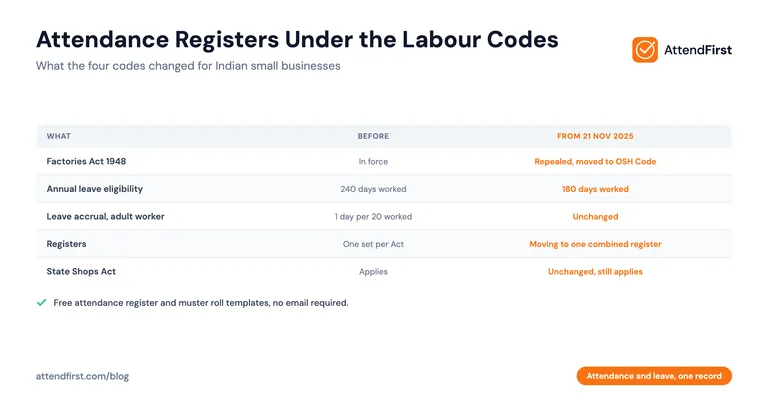
The paperwork around it is where things moved. Under the old regime one employer could be keeping separate registers under the Factories Act, the Contract Labour Act, the Minimum Wages Act, and the Payment of Wages Act, recording much the same facts four times in four layouts. The codes push toward a single combined register covering employee particulars, attendance, wages, and leave, filed with one annual return. Registration went the same way: a site that once needed its own registration under each of those Acts is now expected to hold one, with all-India licences running five years.
Electronic records are no longer a concession you argue for. The codes and the central rules are drafted around electronic registration, electronic registers, and electronic returns as the normal case. A digital attendance record is fine as long as it identifies each worker, records presence day by day, and can be produced during an inspection.
None of that changes what an inspector actually looks for, which is a record written on the day, matching the wages you paid, that somebody other than you could verify. Paper filled in on Friday for the whole week still fails that test, and it always did.
What changed for annual leave under the OSH Code
The headline change is the eligibility threshold for annual leave with wages.
| Factories Act 1948 | OSH Code, 2020 | |
|---|---|---|
| Days of work needed to qualify in a calendar year | 240 | 180 |
| Annual leave earned, adult worker | 1 day per 20 days worked | 1 day per 20 days worked |
| Annual leave earned, adolescent or underground mine worker | 1 day per 15 days worked | 1 day per 15 days worked |
| Carry-forward cap | 30 days for an adult, 40 for a child | 30 days, with the excess encashed at year end |
Dropping the threshold from 240 days to 180 is the change most likely to affect your payroll. A worker who joins mid-year, or whose year included a long absence, now qualifies for earned leave in cases where they previously did not. If your leave policy repeats the 240-day figure, it is understating what your staff are entitled to.
The accrual rate itself is unchanged, which is why so much existing content looks correct at a glance. The number survived. The Act it came from did not, and the qualifying condition moved underneath it.
What did not change: your state Shops and Establishments Act
This is the part people most often get wrong, and for a shop, office, clinic, or restaurant it is the part that matters most.
The four codes consolidate central labour laws. Each state’s Shops and Establishments Act is state legislation and was not part of that consolidation. Karnataka, Maharashtra, Delhi, Tamil Nadu, Telangana, and the rest continue to apply as before.
For most Indian small businesses, that means the law setting your casual leave, sick leave, weekly offs, daily hours, and opening hours has not moved at all. The codes reach you where they replace a central law that also covered you, and where your state notifies code-aligned rules of its own.
So the practical position for a 3 to 15 person business is:
- Shop, office, clinic, restaurant, or retail outlet: your state Shops and Establishments Act still governs leave and hours. Read the codes for the wage and social security duties.
- Factory, or a site using contract labour: the OSH Code has replaced the Act you used to cite. Update the citations and check the 180-day threshold against your leave policy.
- Everyone: state rules under the codes are still in draft in most states, so specific form numbers remain unsettled. Keep the underlying data complete. Which form it gets copied into is then a formatting question rather than a compliance one.
What to do about it this month
Start with the citations in your leave policy and your appointment letters. Anything that names the Factories Act 1948, the Minimum Wages Act 1948, or the Payment of Wages Act 1936 as current law is now wrong, and it is a five-minute edit.
Then check the eligibility line in your leave policy. If it says 240 days and the OSH Code applies to you, you are understating what people have earned. That one can cost you money in a dispute.
Next, try actually producing three years of attendance records. Not confirming that they exist somewhere. Producing them. Retention is rarely what fails on inspection. Retrieval is.
Last, and this is the one worth real effort: stop keeping attendance in one place and leave in another. If attendance sits in a register or a spreadsheet while leave lives in a WhatsApp thread, nobody can reconcile the two at month end, and the number you pay people from is a guess. That was already a problem. The combined register is the law moving in the same direction for the same reason. AttendFirst keeps attendance and leave as one record, with the monthly export already reconciled; the attendance and leave in one record guide covers what that changes at month end.
Templates that match the current position
The codes did not change the formats. An inspector still expects the same columns.
| Template | Use it for | Download |
|---|---|---|
| Monthly attendance sheet | Salaried staff, one row per employee per month | Excel or PDF |
| Muster roll | Workers paid by days worked, contract labour, sites | Excel or PDF |
| Daily attendance sheet | A single day, with in and out times | Excel or PDF |
Free, no email required. For the column-by-column explanation, see the muster roll format guide and the attendance sheet in Excel guide.
Sources, and how current this is
The Ministry of Labour and Employment notified the codes on 21 November 2025. The leave threshold change and the consolidation counts below come from the government’s own release on the OSH Code.
State rules are still in draft across most states, so the register and form numbers you eventually file under can move. The position here is as of 4 September 2026. Check your state labour department’s notifications before you rely on a specific form number.
Frequently asked questions
Are the four labour codes in force in India?
Yes. The Ministry of Labour and Employment brought the Code on Wages 2019, the Industrial Relations Code 2020, the Occupational Safety, Health and Working Conditions Code 2020, and the Code on Social Security 2020 into force on 21 November 2025. Together they replace 29 central labour laws, including the Factories Act 1948, the Minimum Wages Act 1948, the Payment of Wages Act 1936, and the Contract Labour (Regulation and Abolition) Act 1970. Central rules followed in 2026. State rules are still in draft in most states, so the form numbers you file under can differ from one state to the next.
Is the Factories Act 1948 still valid?
No. The Factories Act 1948 was repealed and its provisions were absorbed into the Occupational Safety, Health and Working Conditions Code 2020, which took effect on 21 November 2025. The obligations did not disappear. Working hours, rest intervals, annual leave, and the registers a factory keeps are now read from the OSH Code and its rules instead. Any attendance or leave policy that cites the Factories Act as current law needs its citations updated, even where the underlying rule is unchanged.
Do I still need to keep an attendance register or muster roll?
Yes. The codes consolidated the record-keeping duty rather than removing it. You still have to record who worked, on which days, and for how long, and you still have to produce those records on inspection. What changed is the source of the duty and the direction of travel: the codes move employers toward a single combined register and a single annual return in place of the separate registers each of the old Acts demanded, and they explicitly allow those records to be kept electronically.
What changed about annual leave under the OSH Code?
The eligibility threshold dropped. Under the Factories Act a worker needed 240 days of work in a calendar year to earn annual leave; under the OSH Code the threshold is 180 days. The accrual rate is unchanged at one day of leave for every 20 days worked for an adult worker, and one day for every 15 days for an adolescent worker or a worker employed below ground in a mine. Carry-forward is capped at 30 days, and leave above that cap is encashed at the end of the calendar year.
Do the labour codes replace my state Shops and Establishments Act?
No. The four codes consolidate central laws. Each state's Shops and Establishments Act is state legislation and sits outside that consolidation, so it continues to apply to shops, offices, clinics, and restaurants exactly as before. For most Indian small businesses the state Act remains the law that sets casual leave, sick leave, weekly offs, and daily hours. The codes matter to you where they replace a central law you were also covered by, or where your state adopts code-aligned rules.
Can attendance records be kept digitally under the labour codes?
Yes. The codes and the central rules are built around electronic records, electronic registration, and electronic returns. A digital attendance record is acceptable so long as it captures the same information a paper register would, identifies each worker, records presence day by day, and can be produced during an inspection. In practice a timestamped digital check-in is stronger evidence than a paper roll, because it cannot be filled in from memory a week later.
Get attendance tips for Indian businesses
One practical guide per week. No spam.
Put attendance and leave in one record
Indian holidays and weekly offs come already loaded. Setup takes 5 minutes, and no payment is required to start.