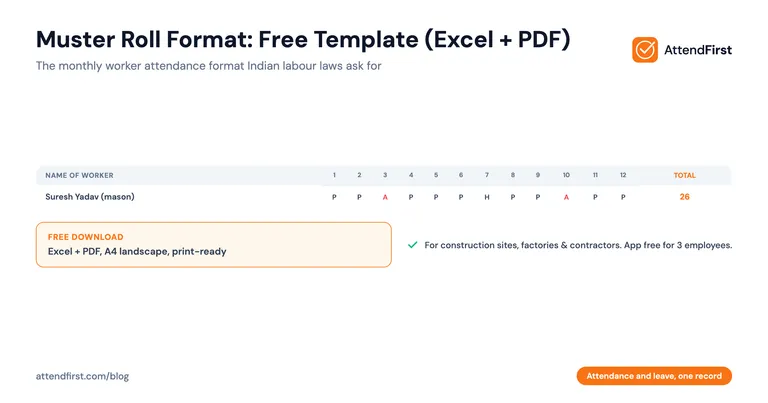
Muster Roll Format: Free Template (Excel + PDF) for India
Payal focuses on leave management and compliance workflows for Indian businesses.
TL;DR: A muster roll is the monthly worker attendance register that Indian labour laws require on construction sites, in factories, and wherever contract labour works. Download the standard format below as Excel or PDF, free. If you searched for MGNREGA muster rolls, those are government-issued - see the note further down.
Ask any site supervisor how wages get calculated and the answer starts with the muster roll. One row per worker, one column per day, P or A in each box, total days at the end of the month, multiply by the daily rate. It has looked the same for decades because it works.
This page gives you the format ready to use, explains each column, and covers which law asks for it.
Download: free muster roll template
| Template | Best for | Download |
|---|---|---|
| Muster roll (Excel) | Maintaining on a computer, sharing with your CA | Download .xlsx |
| Muster roll (PDF) | Printing for the site office, A4 landscape | Download .pdf |
No email required, no watermark. Print the PDF one page per month per 18 workers, or duplicate rows in the Excel file for bigger gangs.
The muster roll format, column by column
| Column | What goes in it |
|---|---|
| Sl No | Serial number of the worker |
| Name of worker | Full name as per ID |
| Father’s / husband’s name | Identifies workers with the same name |
| Designation / category | Mason, helper, operator, supervisor, etc. |
| Days 1-31 | One column per day, marked P (present) or A (absent) |
| Total days worked | Count of P marks, used for wage calculation |
| Signature / thumb impression | Worker’s acknowledgement, usually taken at wage payment |
The header carries the establishment or work-site name and address, the contractor’s name if labour is engaged through one, the month and year, and the nature of work.
Marking: P = Present, A = Absent, H = Holiday, L = Leave. Some sites also mark half days as 1/2. Whatever codes you pick, use them consistently for the whole month - the total column is what wages are paid from, and inspectors compare marks against totals.
Which law requires it
Three overlapping requirements cover most establishments:
- Contract labour: the Contract Labour (Regulation and Abolition) Central Rules prescribed Form XVI, the muster roll every contractor kept for workers on a site. That Act was absorbed into the OSH Code on 21 November 2025. The columns carry over unchanged; the form number now depends on your state’s rules under the Code. Principal employers are still expected to verify it.
- Factories: factories maintain a muster roll of workers under the Occupational Safety, Health and Working Conditions Code, 2020, which replaced the Factories Act 1948 on 21 November 2025. The form number differs from state to state, but the columns match the format above.
- Construction: building and construction work engaging contract labour follows the contractor rules, and several states prescribe muster-roll-cum-wage registers that combine attendance and payment in one book.
Updated for the labour codes. The four labour codes came into force on 21 November 2025 and repealed 29 central laws, including the Factories Act 1948 and the Contract Labour Act 1970. The muster roll duty survived the consolidation; it is the citation that changed. See attendance registers under the labour codes.
The safe position for an SMB: maintain the standard format above, keep it current daily, and keep at least three years of past rolls. If a labour inspector or your principal employer asks for a specific state form, the same data transfers across - the formats differ in layout, not in substance.
Not the MGNREGA muster roll
A lot of “muster roll” searches in India are about MGNREGA. Those muster rolls are government documents: numbered rolls issued to gram panchayats through the MGNREGA portal (nrega.nic.in), with worker attendance captured through the government’s NMMS app. Private templates like the one on this page are not valid for MGNREGA work. Everything here is for private establishments - contractors, factories, workshops, and businesses paying workers by days worked.
Muster roll vs attendance register vs daily sheet
| Muster roll | Attendance register | Daily attendance sheet | |
|---|---|---|---|
| Layout | Monthly grid, 31 day-columns | Bound book, day-wise pages | One page per day |
| Built for | Daily-wage and contract workers | Salaried staff | Salaried staff |
| Records | P/A per day, total days worked | In/out times, signatures | In/out times, signatures |
| Feeds | Wage calculation (days x rate) | Payroll, leave tracking | The day’s summary |
If your workers are paid per day worked, maintain the muster roll. If your staff are salaried with fixed hours, a daily attendance sheet or the monthly attendance sheet fits better. Many businesses run both: muster roll for site labour, attendance sheet for office staff.
Where the paper muster roll breaks
The format is fine. The problems are operational, and anyone who has run a site knows them:
- Proxy marking. One person marks P for a friend who never came. On a 40-worker roll, two ghost workers cost you over 50 paid days a month.
- End-of-week backfilling. The supervisor fills Monday to Thursday from memory on Friday. Totals become guesses.
- One copy, on site, in the rain. Lose the book in month three and you have no wage evidence for a labour dispute.
- Month-end arithmetic. Someone counts P marks across 31 columns for 40 workers, by hand, and the count goes straight into wages. One miscount is one wage dispute.
Maintaining the muster roll digitally
Digital records are accepted as long as they carry the same information and can be produced at inspection. An attendance app changes the evidence quality: each worker checks in with a selfie and GPS location, so every P mark has a timestamped photo behind it. Proxy marking stops. Totals calculate themselves. The month exports to Excel in the layout above for your CA or labour consultant.
For how this works on scattered sites with workers who change every month, see attendance for construction workers.
AttendFirst is built for exactly this scale of business: the muster roll and the leave record are the same record, so the monthly export already accounts for who was off. Workers check in from any smartphone. Teams of 4 to 10 pay a flat ₹3,000/year, ₹499/employee/year beyond that, and up to 3 employees costs nothing. No payment required to start.
Keep the paper roll during transition
Practical advice from sites that switched: run the app and the paper muster roll in parallel for one month. Compare totals at month end. When the app’s totals match (they will, and they’ll surface the marks the paper roll got wrong), the paper book becomes the backup and the app becomes the record. Workers adapt in about a week - checking in with a selfie is faster than queueing to sign a register.
Frequently asked questions
What is a muster roll?
A muster roll is a monthly attendance register for workers, with one row per worker and one column per day of the month. Each day is marked present or absent, and the month ends with a total of days worked, which feeds wage calculation. Indian labour laws require contractors, factories, and construction sites to maintain it in prescribed formats.
What is the format of a muster roll?
The standard muster roll format has these columns: serial number, name of worker, father's or husband's name, designation or category, one column for each day of the month (1 to 31) marked P or A, total days worked, and the worker's signature or thumb impression. The header carries the establishment or site name, contractor name, month, and nature of work.
Which law requires a muster roll in India?
The duty now sits under the labour codes. The Occupational Safety, Health and Working Conditions Code 2020 absorbed the Factories Act 1948, the Contract Labour (Regulation and Abolition) Act 1970, and the BOCW Act 1996 when the four codes came into force on 21 November 2025, so factories, contractors, and construction sites all read their record-keeping duty from that Code. State rules under the codes are still in draft in most states, so the exact form number varies by state, but the columns are nearly identical everywhere.
Is this the MGNREGA muster roll?
No. MGNREGA muster rolls are issued and managed by the government - gram panchayats get numbered muster rolls through the official portal (nrega.nic.in), and attendance is captured through the NMMS app. The template on this page is for private establishments: construction contractors, factories, workshops, and businesses that pay workers by days worked.
What is the difference between a muster roll and an attendance register?
A muster roll is a monthly grid built for daily-wage and contract workers - one row per worker, 31 day-columns, ending in total days worked for wage calculation. An attendance register is the broader day-wise book offices use, usually with in/out times and signatures per day. If workers are paid per day worked, you want a muster roll. If staff are salaried, a daily attendance sheet does the job.
Can I maintain a muster roll digitally?
Yes. Digital attendance records are accepted as long as they show the same information - worker identity, daily presence, and days totals - and can be produced during an inspection. An attendance app that logs daily check-ins with time, GPS location, and photo gives you stronger evidence than a paper roll, and exports the month to Excel in the muster roll layout your CA or labour consultant expects.
Get attendance tips for Indian businesses
One practical guide per week. No spam.
Put attendance and leave in one record
Indian holidays and weekly offs come already loaded. Setup takes 5 minutes, and no payment is required to start.